The 600
I received a really nice 6” Pickett 600 slide rule recently from E-Bay, so thought I’d put down a few thoughts on it, and how it compares to the Pickett N600-ES slide rule of NASA fame. I did a brief synopsis of the N600-ES in this post.
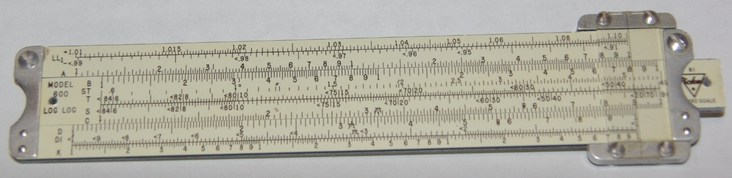
This particular slide rule appears to have been manufactured around 1958, going by the rounded stamped aluminum ends and bars, but especially the logo on the right slide end. Unlike the Hemmi and Post slide rules, it is sometimes a bit difficult to get close to an exact date for Pickett rules.
Let’s see if we can discover any advantages or disadvantages between the two rules. The size is identical at ~ 6” in length.They both have virtually identical layouts, with a few minor differences.
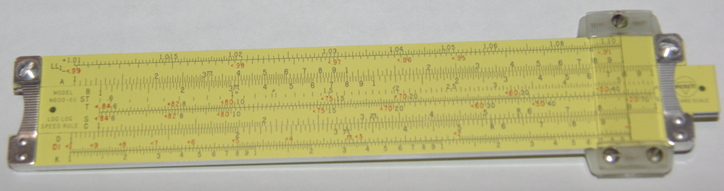
One obvious variation is the “Eye-Saver” yellow background of the N600 vs. the white background of the 600. Additionally, note the red color for reversed scales of the N600-ES, such as the DI, T, S and -LL scales. Admittedly, this makes identification easier for reading those scales. However, this is a minor thing for those familar with slide rule usage.
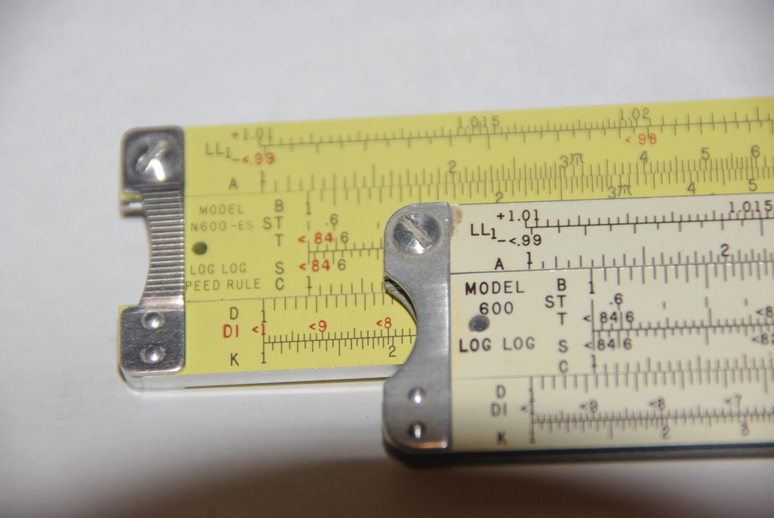
Here is the front of each rule, showing identical scales. Although the 600 scales are black, there are directional ‘arrows’ for the reverse direction numbers.
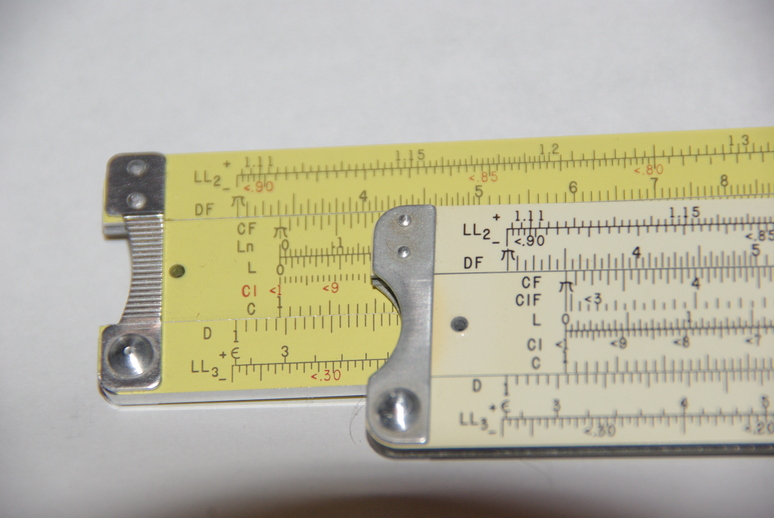
On the back are also shown the same scales. However, the N600-ES has an additional Ln scale just above the L scale. It adds a bit of versatility to that rule versus the 600. But since both rules have the same LL scales, it is not really necessary. One nice feature of both rules is the \(\pi\) symbol on the CI scales. This is not found on many slide rules, but is present on almost all later Pickett rules, like the N-515-T electronic rule made for Cleveland Institute of Electronics, and even the little N1006-T 6” rule. It’s too bad it seems to be missing on the Post 1460/1 series of rules, of which I may feature in a post in the near future.
The bottom line is simply there are not a lot of differences between the two versions of Pickett’s 6” rules.
One thing I have found interesting on the LL scales is they are really handy for determining the powers of numbers, such as \(2.35^{7.2}\). Given that perhaps odd number, we can easily find the answer by setting the index to 2.35 of the LL2 scale, then move the hairline (HL) to 7.2 of the D scale, to read 470 on the LL3 scale. Of course, either slide rule will read answers only to about 22,026. For example, 4.177 would be there, but there are many other combinations, such at 75.14, just for fun.
On these particular slide rules, unlike the big brother N4-ES, there are A and B scales, along with a K scale. Even without the LL scales, we could still do quartics, quintics and sextics very easily, similar to normal squares and cubes. By rewriting the formulas a bit like this, \(x^{4} = (x \times x)^{2}\), \(x^{5} = (x \times x)^{2} \times x\), and \(x^{6} = (x \times x)^{3}\). This allows us to see how the square and cube scales interact.
For a quartic example: 44. Set as normal for multiplication (x2), but look under HL on A scale, read 256.
For a quintic example: 3.75. Set as normal for multiplication using the reciprocal (D and CI scales), look under HL as above (A scale, x4), but slide HL to 3.7 on B scale, read 693 under HL on A scale.
For sextics, the K scale is also used, 4.76. Set for D and CI scale multiplication (x2), move cursor to index, read K scale for 10,800.
As the saying goes, “There are many ways to skin a cat!” Cat lovers may be offended by that saying, but it is only metaphoric.
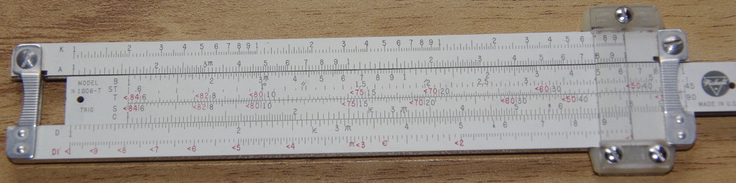
I was examining the Trademark/Logo on the slide rules, and noticed there were three different logos on the rules, this including the 6” N1006-T mentioned briefly above. The 600 has the Style 3 (1950-1958), the N1006-T the Style 4 (1958-1962), and the N600-ES the Style 5 (1962-1975).
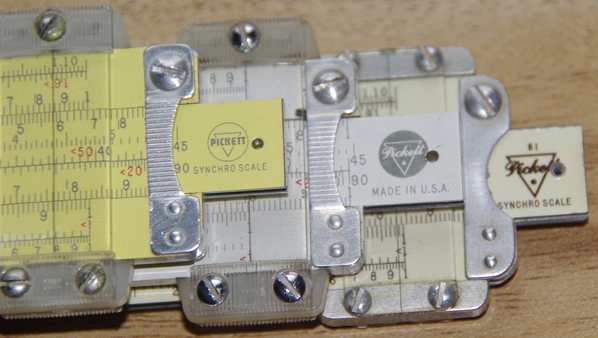
In the above image, the oldest is on the right, the newest on the left. I have rules with other logos and date ranges, but the 6” rules are especially handy for most anything. And easier to carry around! Batteries Not Included!
Have a great day in the Lord Jesus Christ! We always thank God for everything we have, where we live, and His great creation all around us! If you have not accepted Jesus as your Lord and Savior, there’s no time like the present. Don’t wait until it’s too late!