Slide Rules on the Moon
Earlier this week, I finally managed to acquire a Pickett N600-ES Slide Rule. They are not rare, but many folks selling them seem to think they are rare as hen’s teeth, and price them accordingly! Reality check, folks! Ok, I am finished venting…
First, I like Pickett slide rules. Why? Well, because they are pretty durable, being made of aluminum. Other materials are more affected by hot, cold, moisture, storage conditions, and other factors. Aluminum is pretty stable.
Now, having said that, purchasing a slide rule can be a challenge, especially if one wishes to get one in good shape. Download the images available and enlarge them to examine the faces and scales for damage. I, personally, don’t wish to just collect them for the sake of having them. I want one that is perfectly useable and functional. I am not a collector of slide rules!1 If I were, I would most likely have many different brands and types, which I don’t. The only other rule I find interesting is the K&E 68-1130 model 6” slide rule.
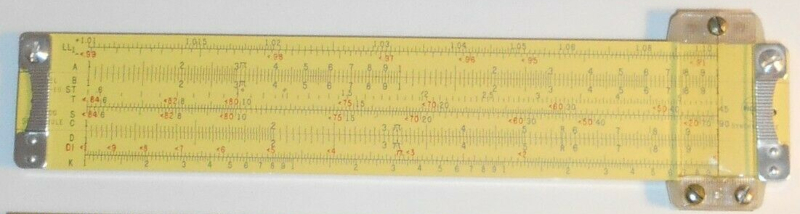
Pickett N600-ES Slide Rule Front.
Now, to the point. The Pickett “Synchro Scale” N600-ES2 Log Log Speed Rule has an interesting history3 It was supposedly4 taken on five missions as a backup calculator for the ancient5 computers used in the Apollo program space vehicles. For example, Astronaut Dr. Buzz Aldrin6 supposedly used his “slipstick” N600 for some calculations during his Apollo 11 flight to the moon. His particular N600 which he probably bought for $10.95 was sold at auction for a measly $77,675 in 2007.
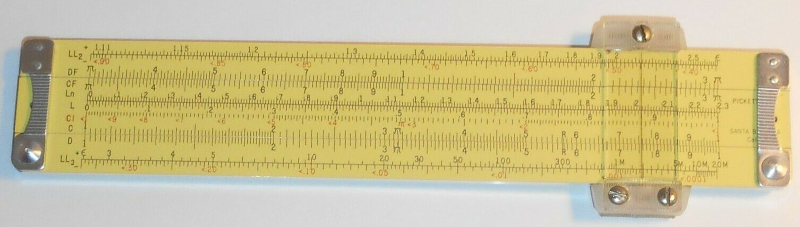
Pickett N600-ES Slide Rule Back.
Pickett used the fact in their advertising of the N600 as early as 1968, a bit before the Apollo 8 lunar orbit mission of December, 19687. Forward thinking on their part, I suppose.
Of course, the next decade saw the end of the slide rule as four function calculators appeared on the scene and became affordable. I myself bought my first Texas Instrument (TI) calculator in the mid-70’s. I never owned a slide rule during my school years as even by that time they were on their way out. These days slide rules are only a novelty to most people, and a collectible for others. The slide rule was for a time when folks used their brains and understood how mathematics worked. Nowadays, students have been observed using their calculators to add 1 plus 1. Not a pretty sight!
This particular Pickett N600-ES has 22 scales. On the front are LL1, -LL1, A [ B, ST, T, S, C ] D, DI and K; on the back are LL2, -LL2, DF [CF, Ln, L, CI, C] D, LL3 and -LL3. The [] brackets denote the scales printed on the slide. The LL/-LL and Ln/L scales are printed back-to-back to save space.
There are three sets of Log-Log scales on the N600. The LL1 through LL3 scales cover natural logs of numbers from 1.01 to 22,026 where the answer is read directly on the D scale. Answer range for LL1 is 0.01 to 0.1, LL2 is 0.1 to 1, LL3 is 1 to 10. For numbers less than 1, the -LL1 through -LL3 scales are used, and are the reciprocal of the LL scales. They cover the range 0.00045 to 0.99. The answer is negative and found on the D scale with the same range of digits as the LL scales.
The A and B scales are doubled and indicate the square of numbers on the D scales.8 Below the D scale is the DI scale, the reciprocal of the D scale, useful if the slide projects far out to the side during multiplication or division on the C and D scales. Also on the right A scale is a mark at 0.7854. By setting the right slide index there and moving the cursor (or hairline) to a circle diameter on the C scale, the area of a circle ((r^{2})) is read on the A scale under the cursor.
Below that scale is the K scale, which is tripled and indicate the cube of D scale numbers.9
The slide on the same side contain the Sine, Tangent and ST scales for trigonometry calculations involving sines, cosecants, cosines, secants, tangents and cotangents.
The slide rule back side has, in addition to the LL scales already mentioned, the CF/DF scales, the Ln and L scales, a CI scale, and another C/D scale. The CF/DF is a C/D scale folded at (). This allows direct reading of circle circumference ((d)) set on the D scale on DF. The CI scale in the reciprocal of the C scale.
The Ln scale allows direct reading of natural logs of numbers on the C scale between 1 and 10. The LL scales mentioned above allow a greater range. The (Log_{10}) scale below the Ln scale shows the mantissa of a number. The characteristic is determined by the digit count less one.
Another useful mark on the C and D scales is a small R located at 57.3, used to convert degrees to radians and vice versa (2() radians = 360o).
On the ST scale are several marks: ’ (minute) and ” (second). These are for finding sines of minutes and seconds. If these marks are aligned with a minute or second on the D scale, the sine is at the slide index on the D scale. For example: 1’=0.00029 (Three zeros and a three), 1”=0.0000048 (Five zeros and a five).
So, lots of capability in a 6” slide rule. Easily fits into a pocket, and doesn’t need batteries!
We thank God for His Grace and Providence for us, and in His Son Jesus, for His sacrifice to redeem us! Praise God!
-
I do have a small collection of Pickett slide rules.↩︎
-
the ES stands for “Eye Saver.”↩︎
-
Not this particular slide rule, but the N600 series.↩︎
-
See this site for more info: https://www.rfcafe.com/miscellany/smorgasbord/Great-Pickett-Slide-Rule-Apollo-Conundrum.htm↩︎
-
Compared to modern computers↩︎
-
Lunar module pilot for Apollo 11 mission: https://en.wikipedia.org/wiki/Apollo_11.↩︎
-
Apollo 8 mission https://en.wikipedia.org/wiki/Apollo_8↩︎
-
And C scale if aligned with D scale↩︎
-
And C scale if aligned with D scale↩︎