Slide Rules For Fun
Some time ago I remember doing a post about slide rules in Slide Rules on the Moon. However, it occurred to me I had never really delved into the subject deeper than that. So you’re thinking, “That’s a really OLD instrument, given that calculators have long taken over from that mechanical method of calculation!” Well, that is certainly true, in all respects.1 The slide rule’s demise was written when the first solid-state electronic desk calculator came out in the early 1960s, and the first handheld calculator in the 1970s. I remember my first Texas Instruments 4-function calculator I acquired in the late ’70s. But this post is about the slide rule which was used by calculators, who were also known as Humans. How the term has changed! Here is a quote from the book, “All About Slide Rules,” by the Oughtred Society,
It is interesting to consider that virtually all bridges, buildings and other structures built in the past three hundred years or more were designed with an ordinary ten inch slide rule. This includes the Brooklyn Bridge, Hoover Dam, Empire State Building, roadways and land reclamation projects, and the design of cities and waterways all over the world. Airplane design, basic and advanced electronic design and space ballistics work was also done with a slide rule.
I am not a collector of slide rules. A collector is someone who (usually) acquires slide rules of all makes and models, hopefully in pristine or near perfect condition, or perhaps rare models of particular brands, and may also include accessories such as the boxes they came in, or perhaps sales displays of such.
I am more of a preserver of slide rules, not for the sake of having them, but to acquire working models before they are relegated to the dustbin of history. Nowadays, slide rules can be found on online websites such as E-Bay, and others. Some are moderately priced, some dirt-cheap, and some few expensive. The drawback is determining whether the item of interest is in good condition, or not. Did I mention working models? I am only interested in ones which the scales are in near perfect condition, as I prefer to actually use the rule, not just look at it. In addition, I have only really been interested in the Pickett line of slide rules, preferably the “Eye Saver” version, which is a yellow background aluminum rule.
So, for about two years, I was bitten by the bug to see what I could get, while they were still available, in good condition. This little spurt in interest started about 2015. During that time I managed to collect a fair range of rules with a wide variety of available scales and functions, from a basic N902-T, which was actually white-scaled,

to the really nice N4-ES, which has almost any scale imaginable.
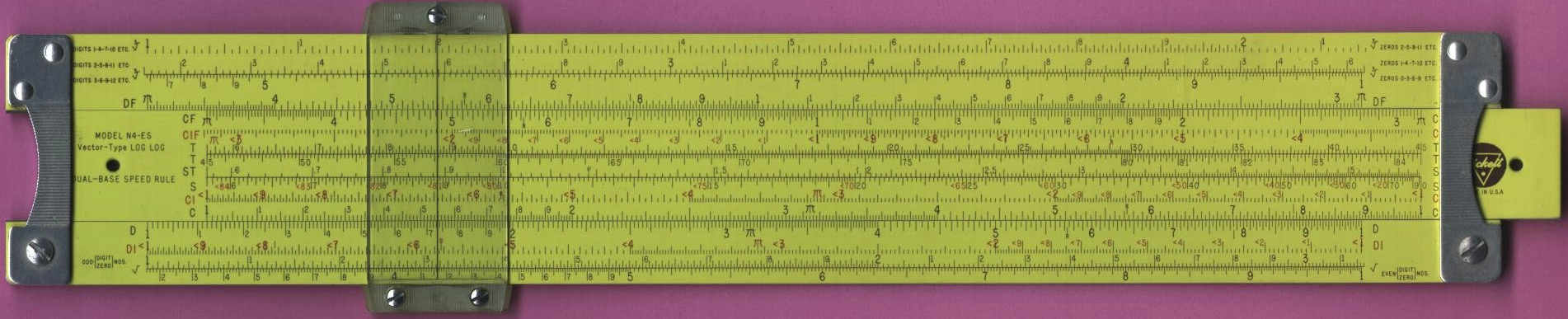
Even though I keep the N4-ES on my desk, my favorite has to be the N3P-ES, which I managed to find brand-new.
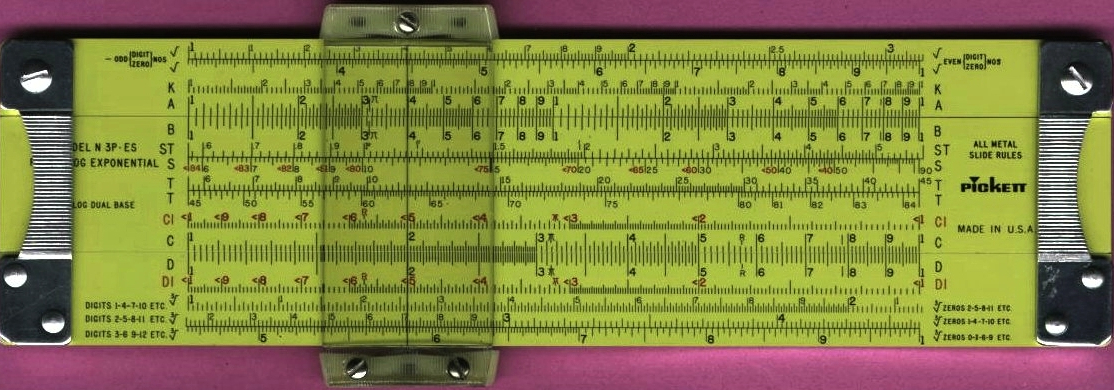
The N3P-ES is not a full 10” rule, but only about 6” long. Very handy for a full function slide rule.
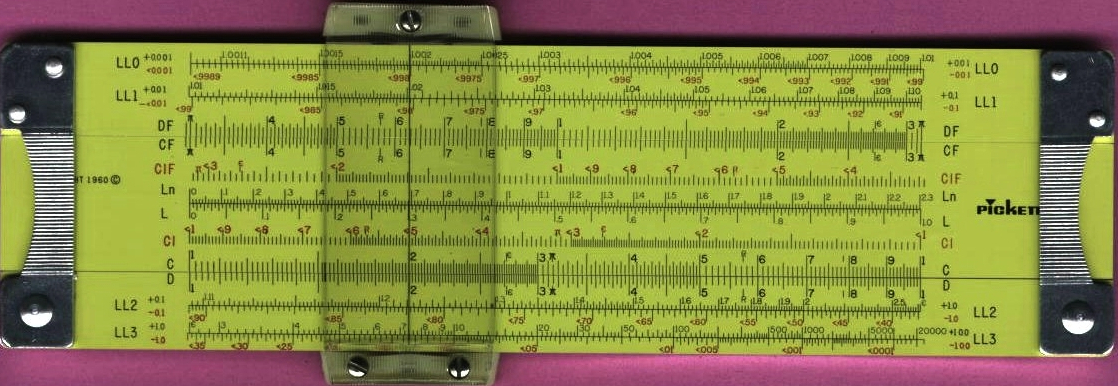
Even though the N4 and N3 are similar, one difference, other than scale placement, is in the Log-Log (LL) scales. Where the N3 reads the natural logarithm answer on the D scale, the N4 reads the answer on the DF/M scale, and log10 on the D scale. Also natural logs of up to 1010 can be found on the N4, but only to 22,026 on the N3.
Another specialty slide rule was developed especially for the Cleveland Institute of Electronics, the N515-T. It can assist in determining many common electronic values, such as inductive and capacitive reactance, resonance, and also assists in decimal placement.

The front has normal scales in addition to special scales for the above mentioned calculations.

The back has quick scales for determination of the same, with the additional assist of decimal placement for the solution. And as a check, the front can determine a more exact value.
And with that, comes one of the drawbacks of the slide rule, decimal placement. The modern handheld calculator will display a solution to any function or calculation and show the exact answer, including the decimal placement. The slide rule does not do that. On the other hand it will scale to any value for any input.
So before I get to decimal placement, let’s explore the proportion function of a slide rule, which a calculator cannot do, without programming. What I mean is the slide rule can create a table of any numbers or ratios set on the scales, automatically. For example, the formula \(\frac{R}{S} = \frac{T}{X}\). If I set R on the C scale opposite S on the D scale, under T on the C scale, I can read X on the D scale. So for any value of T, I can instantly read the appropriate X value.

In the above example, I show \(\frac{7}{22} = \frac{13}{41}\), with 7 and 22 on the C and D scales and the answer to 13/x where x=41 on the CF/M and DFM scales, so I wouldn’t have to swap ends on the C/D scales. The point is any other number ratio is instantly available simply by setting the hairline (HL) to that number.
Now, on to decimal placement. Some slide rules have nice assists on the backs. Others leave it up to the user to keep track of where any decimal should go. In earlier times, before today’s students were observed using a calculator to add 1+1, they were actually taught how to do math, and to understand what the answer actually meant. In other words, the student was taught what ballpark results could be expected from a calculation, so could then determine what the answer should look like. However, a few simple rules can be determined when using a slide rule to perform calculations.
Firstly, let’s define the parts of the slide rule. Looking at any of the above images, the stock is the rigid body. The slide is the movable center and the hairline (HL) is on the movable cursor.
- Multiplication with the C and D Scales.
- If the slide projects to the right of the stock, the digit count for the product is one less than the sum of the digit counts for the multiplicand and multiplier.
- If the slide projects to the left of the stock, the digit count for the product is equal to the sum of the digit counts for the multiplicand and multiplier.
- Multiplication with the CI and D Scales.
- If the slide projects to the right of the stock, the digit count for the product is equal to the sum of the digit counts for the multiplicand and multiplier.
- If the slide projects to the left of the stock, the digit count for the product is one less than the sum of the digit counts for the multiplicand and multiplier.
- Division with the C and D Scales.
- If the slide projects to the right of the stock, the digit count for the quotient is one more than the digit count for the dividend minus the digit count for the divisor.
- If the slide projects to the left of the stock, the digit count for the quotient is equal to the digit count for the dividend minus the digit count for the divisor.
- Division with the CI and D Scales.
- If the slide projects to the right of the stock, the digit count for the quotient is equal to the digit count for the dividend minus the digit count for the divisor.
- If the slide projects to the left of the stock, the digit count for the quotient is one more than the digit count for the dividend minus the digit count for the divisor.
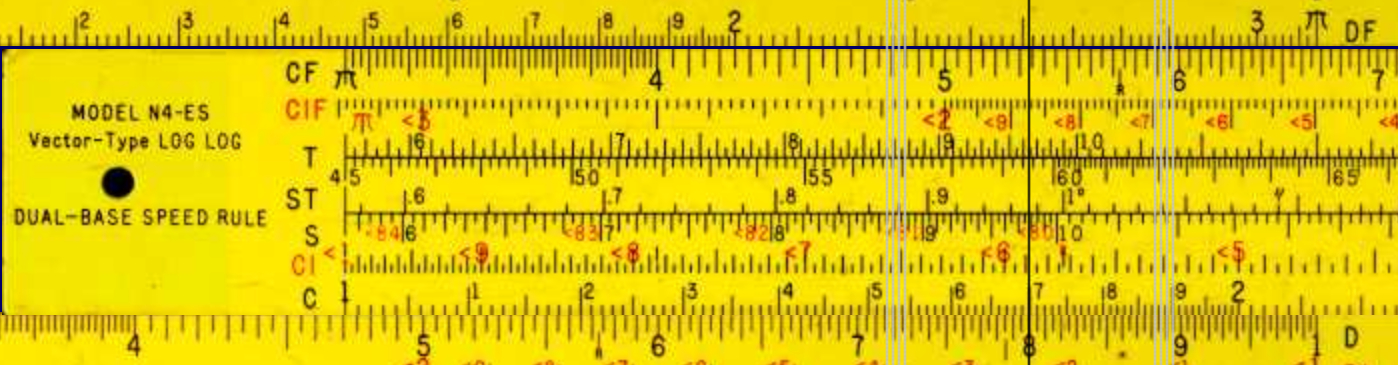
As can be seen, after some use and familiarity, the above can become second nature, assisted by keeping track of what a particular result should look like. Here’s another simple example to illustrate that, shown below. To determine 8/17, where 17 (C scale) is placed over 8 (D scale), and the slide end is at 4.7 (or 47, or 470), you know the answer must be a number less than 1 and is 0.47.
One side exploration from the Pickett line was acquiring a couple of Gilson and midget circular slide rules. However, after using them a bit, I decided I really did not like the vast differences in operation, so lost interest.
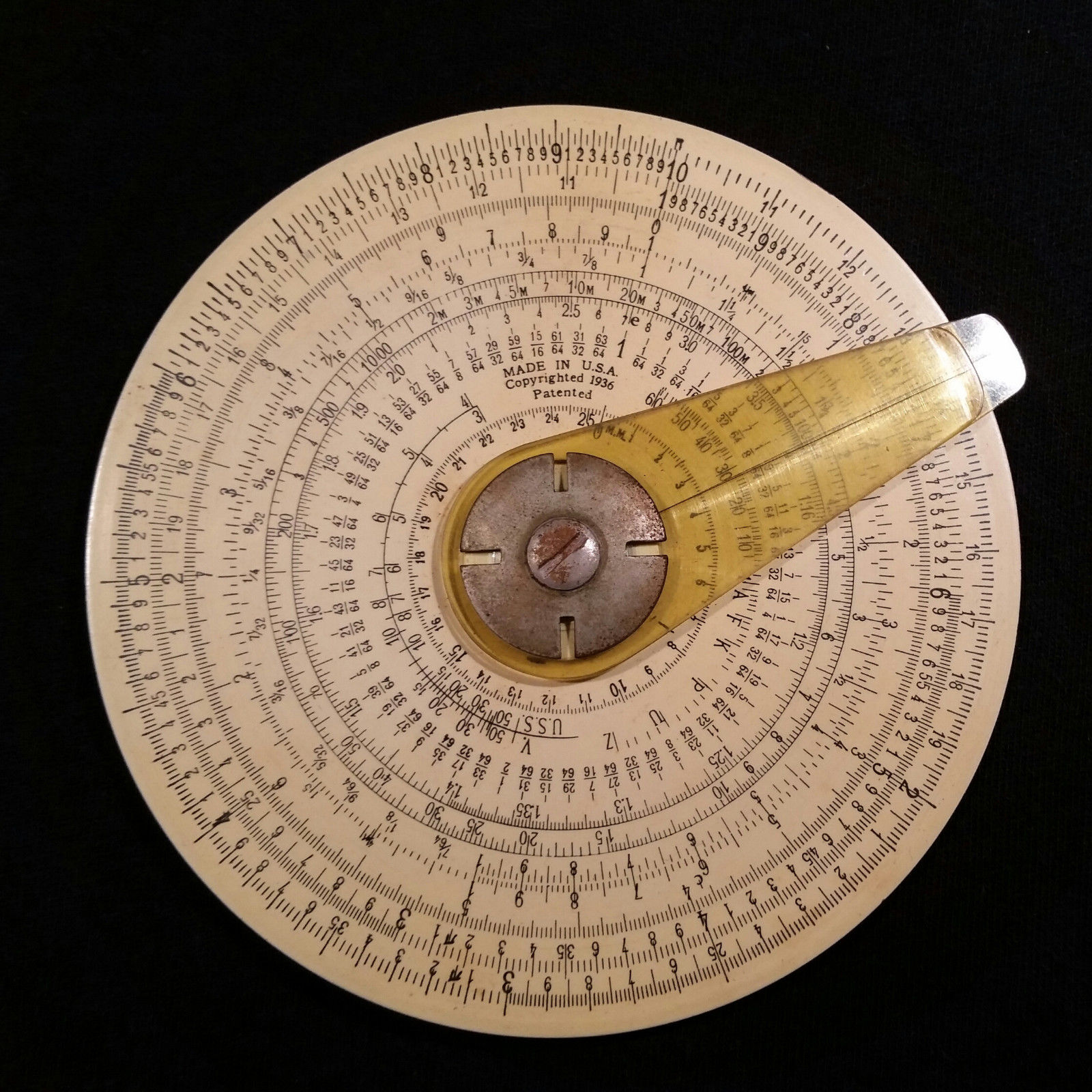
The only other slide rules I had an interest in were the 6” K&E 68-1130 Deci-Lon and the K&E Analon.
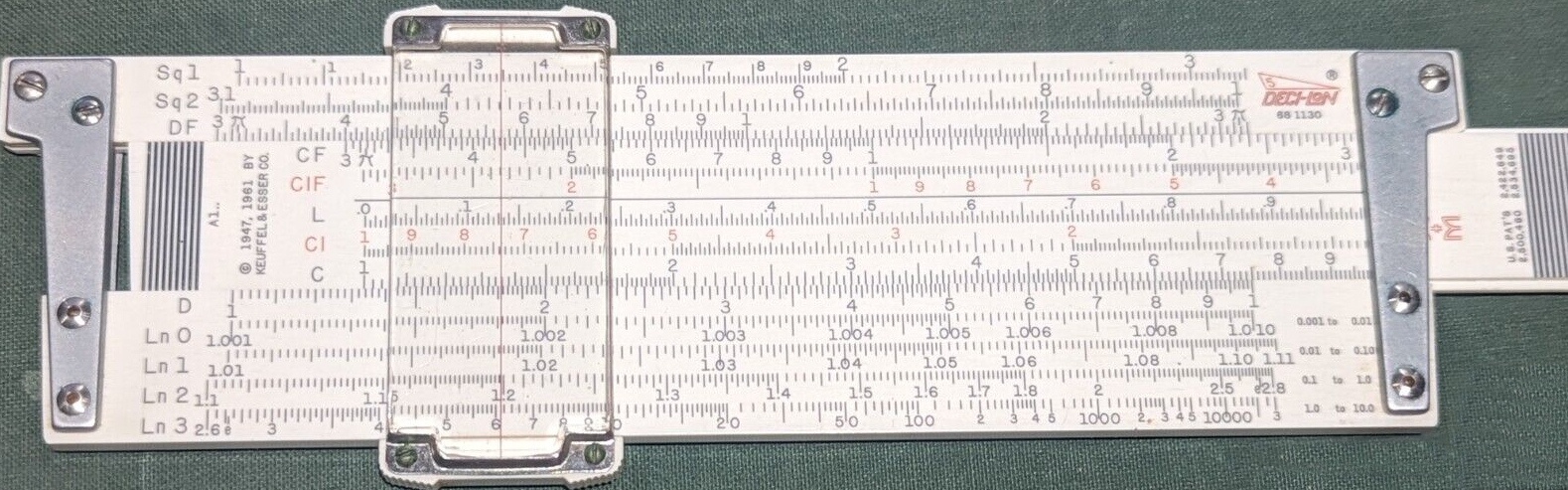
The Deci-Lon is compact, but if I had to choose, I would still select the Pickett N3P-ES. The Analon is unusual as the majority of the scales are marked using dimensional analysis characters, such as length, mass, time and electric charge, based on the meter, kilogram, second and coulomb (MKSC) units. Less than 1000 were ever produced toward the end of the slide rule era, so are virtually impossible to find.
I could go into methods of using the slide rules; but, that would make this post extremely long! There are many printed books available that do a professional job of usage and methodology, usually found online or in used bookstores. So, in any case, I hope you enjoy this short dissertation into slide rules.
Stay safe, and may God Bless you and yours. If you have not accepted Jesus as your Lord and Savior; remember, you don’t have to get a lobotomy to do so. The evidence is everywhere of His great love for you as an individual. How can you deny the evidence of God’s creation all around you. Bye for now.
And, oh by the way, the James Webb Space Telescope (JWST) latest data had virtually proven the Big Bang Theory is bunk…
Footnotes
What do you do when you run out of calculator batteries, and you may need to do some complicated calculation? You pick up a slide rule.↩︎