
Casual Microstrip Design 3
mathematics
electronics
This is part 3 of this unintentional series of casual microstrip design. Here I will expand a bit on an article I saw entitled, “A Designer’s Guide to Microstrip Design,” and attempt to recreate a portion of the article1, (Bahl and Trivedi 1977), from the May 1977 issue of Microwaves Journal. I originally came across the reference in (Pozar 2012) Chapter 3, where I was investigating frequency effects on microstrip lines, and wanted to repeat some of the explanation and formulae here.
One area I found interesting was the formulae for Zo and Eeff and the variance as the impedance changes. The width of a microstrip is primarily determined by the substrate thickness and system impedance, whereas the length is a function of frequency. Obviously, frequency plays into all the factors, and has the most impact as it reaches the 2 GHz and above range.
Firstly, a bit of background. Since field lines between the strip and the ground plane are not contained entirely in the substrate, the propagating mode along the strip is not purely transverse electromagnetic (TEM) but quasi-TEM. Assuming the quasi-TEM mode of propagation, the phase velocity in microstrip is given by \[\begin{equation} V_p = \frac{c}{\sqrt{\varepsilon_{eff}}} \end{equation}\] where c is the velocity of light2, and \(\varepsilon_{eff}\) is the effective dielectric constant of the substrate material. The effective dielectric constant is lower than the relative dielectric constant, \(\varepsilon_r\), of the substrate, and takes into account external fields. The wavelength, \(\lambda_g\), in microstrip line is given by \[\begin{equation} \lambda_g = \frac{V_p}{f} \: (in \: m/s) \end{equation}\] where f is frequency. The characteristic impedance of the transmission line is given by \[\begin{equation} Z_o = \frac{1}{V_p C} \end{equation}\] where C is the capacitance per unit length of the line. The analysis for the evaluation of \(\varepsilon_{eff}\) and C based on quasi-TEM mode is fairly accurate at lower microwave frequencies. At higher frequencies, the ratio of longitudinal-to-traverse electric field components becomes significant and the propagating mode can no longer be considered quasi-TEM. Analysis of this “hybrid mode” is far more rigorous.
Closed-form expressions.
Closed form expressions by Hammerstad3 for Zo and \(\varepsilon_{eff}\) include useful relationships defining both characteristic impedance and effective dielectric constant:
For W/h \(\leq\) 1, \[\begin{equation}
Z_o = \frac{60}{\sqrt{\varepsilon_{eff}}} ln(8 h/W + 0.25 W/h)
\label{eq:zo4}
\end{equation}\] where: \[\begin{equation}
\varepsilon_{eff} = \frac{e_r + 1}{2} + \frac{e_r - 1}{2} [(1 + 12 h/W)^{-1/2} + 0.04(1 - W/h)^2]
\label{eq:zo5}
\end{equation}\] For W/h \(\geq\) 1, \[\begin{equation}
Z_o = \frac{120 \pi / \sqrt{\varepsilon_{eff}}}{W/h + 1.393 + 0.667 ln(W/h + 1.444)}
\label{eq:zo6}
\end{equation}\] where: \[\begin{equation}
\varepsilon_{eff} = \frac{e_r + 1}{2} + \frac{e_r - 1}{2} (1 + 12 h/W)^{-1/2}
\label{eq:zo7}
\end{equation}\] Hammerstad notes that the maximum relative error in \(\varepsilon_{eff}\) and Zo is less than \(\pm\) 0.5 percent and 0.8 percent, respectively, for 0.05 \(\leq\) W/h \(\leq\) 20 and \(\varepsilon_r \leq\) 16. His expressions for W/h in terms of Zo and \(\varepsilon_r\) are:
For W/h \(\leq\) 2, \[\begin{equation}
W/h = \frac{8 e^A}{e^{2A}-2}
\end{equation}\] For W/h \(\geq\) 2, \[\begin{equation}
\begin{split}
W/h = \frac{2}{\pi} [B - 1 - ln(2 B - 1) + \\
\frac{\varepsilon_r - 1}{2 \varepsilon_r} \left(ln(B-1) + 0.39 - \frac{0.61}{\varepsilon_r}\right)]
\end{split}
\end{equation}\] where: \[\begin{align*}
& A = \frac{Z_o}{60} \sqrt{\frac{\varepsilon_r+1}{2}} + \frac{\varepsilon_r - 1}{\varepsilon_r + 1} (0.23 + 0.11/\varepsilon_r) \\
& B = \frac{377 \pi}{2 Z_o \sqrt{\varepsilon_r}}
\end{align*}\] These expressions provide the same accuracy as the previous four expressions. So, if we provide a situation where we vary input impedance, Zo, and using a substrate er = 9.8 with a thickness of 1.6 mm, we see how the Eeff and W/h ratio varies.
The results discussed above assume a two-dimensional strip conductor. But in practice, the strip is three-dimensional; its thickness must be considered. However, when t/h \(\leq\) 0.005, 2 \(\leq \varepsilon_r \leq\) 10, and 0.1 \(\leq\) W/h \(\leq\) 5, the agreement between experimental and theoretical (t/h=0) results is excellent. 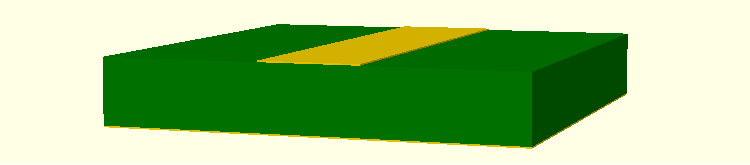 The zero-thickness (t/h=0) formulas given above can also be modified to consider the thickness of the strip when the strip width, W, is replaced by an effective strip width, We. Expressions for We are:
For W/h \(\geq 1/2 \pi\), \[\begin{equation}
\frac{W_e}{h} = \frac{W}{h} + \frac{t}{\pi h} \left(1+ln \frac{2h}{t}\right)
\end{equation}\] For W/h \(\leq 1/2 \pi\), \[\begin{equation}
\frac{W_e}{h} = \frac{W}{h} + \frac{t}{\pi h} \left(1+ln \frac{4 \pi W}{t}\right)
\end{equation}\] Additional restrictions for applying these equations are t \(\leq\) h and t < W/2. Typical strip thickenss varies from 0.0002 to 0.0005 inch (5.1 um to 12.7 um) for metalized alumina substrate, and from 0.001 to 0.003 inch (25 um to 76 um)4 for low-dielectric substrates.
Microwave enclosures tend to lower impedance and effective dielectric constant. But when the ratio of the distance between the lower and upper walls to substrate thickness is larger than five, and the sidewall spacing is five times the strip width, the enclosure effect is negligible on microstrip characteristics. BTW, my rendition of the article is here.
My next effort may be designing some actual filters using foil tape on a PCB, a concept I came across on the Internet recently. Well, that’s all for this post. We always praise God for providing what we need, and His Son Jesus, where because of His great sacrifice, allows us to be reconciled with the Father, if we accept His free gift of Salvation.
References
Bahl, I. J., and D. K. Trivedi. 1977. A Designer’s Guide to Microstrip Line. Microwaves, 1977-05 Vol 16 Issue 5. Penton Media, Inc.
Pozar, David M. 2012. Microwave Engineering, 4th Edition. West Sussex, United Kingdom: Wiley & Sons, Ltd.
Footnotes
Submitted by Dr. I. J. Bahl, and D. K. Trivedi, Research Engineers, Indian Institute of Technology, Advanced Centre For Electronic Systems, Department of Electrical Engineering, Kanpur-208016, India.↩︎
Lightspeed is 2.99792458e8 m/s.↩︎
E.O Hammerstad, “Equations For Microstrip Circuit Design,” Proc. European Microwave Conference, Hamburg (Germany), pp. 268-272, (September 1975).↩︎
35 um is average thickness for 1 oz copper traces.↩︎