Using Deci-Lon Scales
Introduction
This short article will focus on some of the K&E Deci-Lon slide rule scales, and how to use them. The main reference is the K&E manual, (K&E 1962).1 The Deci-Lon added some scales, usually not present on most modern slide rules. The scales in question are the A and B scales. Simpler slide rules do have them, but more high-end rules removed them in favor of other scales. For example, the Pickett N4-ES removed them in favor of CF/M/DF/M scales. The Post Versalog also removed them. However, the Pickett N3-ES retained them. The N3-ES is mostly identical to the Deci-Lon, but retained the separate Ln scale. Both have the same LL scales, but the Ln scale on the Pickett adds another level of versatility.
Folded Scales
The greatest advantage of the folded scales, CF/DF, are in operations normally done on the C/D scales, but where one of the desired numbers is off the end which would require swapping ends to accomplish. Most operations can be performed on the CF/DF scales without requiring changing the index.
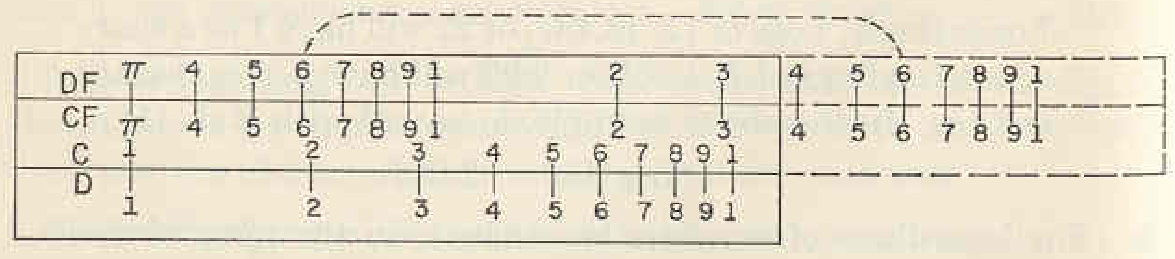
As the above image shows, when numbers are set on the C/D scales, the same numbers appear on the CF/DF scales. So, to perform operations, just think of the scales as flipped (i.e., CF over DF like C over D).
If we align the C index with 2 as in the below image, we see the CF index aligned with 2 on the DF scale, as is all other numbers shown on the scales.

Also note the CF index is near the center of the slide, which allows numbers that would be off the ends on the C scale, usable on the CF scale.
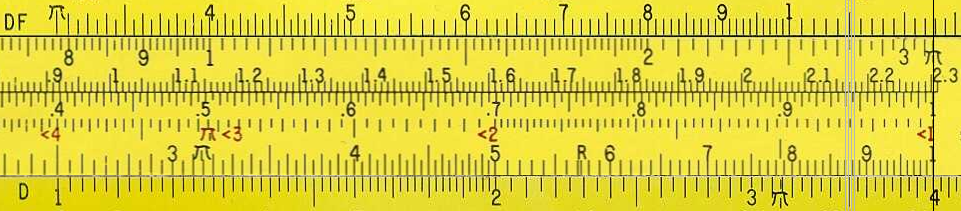
Another advantage of the CF/DF scales is they are folded at PI (\(\pi\)), which allows easy multiplication and division of formulas that include \(\pi\).2 So, for example, to determine \(4 \pi\), we could set 4 of the red CI scale under \(\pi\), and see 12.57 on the DF scale at the CI or C index. We could have used the CF scale instead of CI, but this required less movement of the slide.
Conversely,to divide \(\pi\) by 4 we could set 4 of the CF scale under \(\pi\) on the DF scale, and notice 0.785 on the DF scale at the CF index.
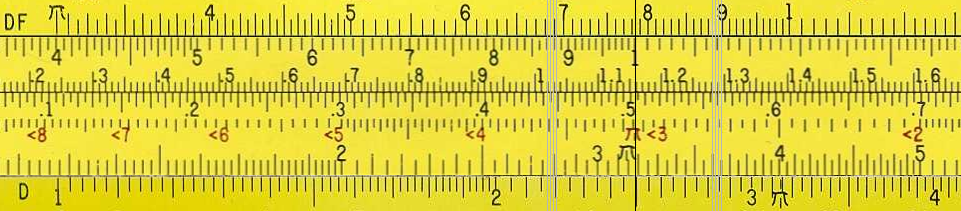
This was to show there are many combinations of scales to use to accomplish the same operation.
Inverted Scales
One main purpose of the inverted scales is to find the reciprocal of a number. A reciprocal of a number is 1 divided by that number, or \(\frac{1}{N}\). The K&E Deci-Lon has three inverted scales. Those are the CI, DI and CIF scales. They are numbered like the C, D and CI scales but from right to left instead of left to right. As they are paired with their counterpart scales, this allows easy multiplication or division of reciprocals of numbers in one simple operation.

Above is seen the CI and C scales showing the reverse numbering direction. This allows the equivalent of multiplying by the reciprocal of a number instead of dividing by the number, or dividing by the reciprocal of a number instead of multiplying by that number.
Let’s say for example we wished to multiply 23 by the reciprocal of 13 (\(23 \times \frac{1}{13}\)).

We set the right index at 23, slide the hairline (HL) to 13 on the CI scale (reciprocal is 0.077), and see 1.77 on the D scale. This operation is the same as \(\frac{23}{13}\).
The CIF scale is both inverted and folded. This allows it to perform where the number may be off the scale as a similar situation with the C/D scales and the CF/DF scales.
A, B, Sq and K Scales
Now we arrive at the main subject, as noted in the introduction. Many slide rules have removed the A/B scales as redundant to the R, Sq or \(\sqrt{}\) scales. However, the K&E Deci-Lon slide rule has included them. This allows more combinations and manipulations than without. This makes it much easier to find squares and square roots in conjunction with the C and D scales.


The A/B scales are twice the C/D scales, giving the square of the C/D setting. Conversely, a number on the A or B scales gives the square root on the D or C scales. Set a number with odd number of digits on the left side, and even number of digits on the right side. For example, a \(\sqrt{4}\) on the above A scale would be 2 on the D scale, but a \(\sqrt{40}\) would be 6.32.
On the Deci-Lon, the K cube/cube root scale (\(\sqrt[3]{}\)) is on the body, so is best used with the D scale. It has the equivalent of three D scales, so each section is 1/3 of, or three times the D scale.

So if you had a number with one, two, or three digits, you would use a different section. Using the above image, for example, \(\sqrt[3]{2} = 1.26\), \(\sqrt[3]{20} = 2.7\), and \(\sqrt[3]{200} = 5.85\). This format would continue with 4, 5, 6 digits, and so on. The below chart indicates which section to use for the square and cube scales, and the number of digits or zeros in the answer.
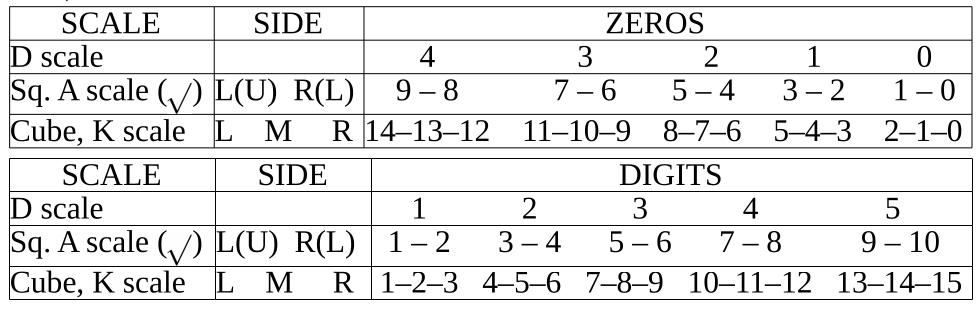
So, if we desired the cube of a 3-digit number on the D scale, the answer on the K scale would have 7, 8 or 9 digits for the cube, depending on which section used.
For squares, the 3-digit number is set on the D scale, and the answer is on the A scale. For square roots, reverse the procedure.


Using the (\(\sqrt{}\)) scale for squares, the number is set on the Sq scale and the answer is on the D scale. For roots, (\(\sqrt{}\)) on the chart, set number on D scale but swap the digit counts.
Other scales
NOTE: Most special, or locating, marks are on the reverse, or red, side scales.
SRT Scale
The other scales on the Deci-Lon are pretty standard. However, one scale worth mentioning is the SRT scale for small angles from 0.57o to 5.7o. This scale extends a bit more on the ends, from 0.55o to 6o.3 This overlap is handy when working close to the ends, especially between the SRT and S scales. Most slide rules end the scales at 5.7o. For angles smaller than 0.57o, the same SRT scale can be used by adding another zero to the range, for 0.001 to 0.01.
Additionally, the LL/-LL scales and the trigonometric scales have legends at the right ends to determine answer ranges. Also, for small angles < 5.7o the sine, tangent and radians are approximately equal.
Some slide rules have minute (’) and second (“) marks on the SRT (or ST) scales. The Deci-Lon has those marks on the C and D scales, denoting sine of 1 minute as 0.00029 (*three zeros and a three), and sine of 1 second as 0.00000485 (five zeros and a five). Each minute and each second increase by the same amount.
So, if we wanted the sine of 3 minutes,we would set the HL to the minute (’) mark on the D scale, flip the rule and slide 3 on the CI scale under the HL (denoting multiplication), and read 0.00087 on the D scale at the index. If we wished to convert that to degrees, we set that on the C scale and read 0.05o on the SRT scale.
Lastly, on the SRT scale is a 1o mark, where if we set the HL there we read the sine as 0.01745 on the C scale.
Radians
To begin with the SRT scale, if an angle is set here, the radians are shown on the C scale prefixed with 0.0. So 2o is 0.0349 radians. As \(\frac{360^{o}}{2 \pi} = 57.2958^{o}\) = 1 radian, we can verify by \(\frac{2}{57.2958} = 0.0349\). Conversely, if we have a radian value of 0.025, we see that is 1.43o on the SRT scale.
Notice on the C and D scales, there are several small R symbols at 57.3. If we set the index here and move the HL to \(\pi\) on the C scale, we see 180o on D. For the HL at the \(2 \pi\) symbol, see 360o on D. So any radian reading on C shows the angle on D.
Area
On the reverse A, B, C and D scales is a small tick mark at \(\frac{\pi}{4} = 0.7854\). This is used to determine area, given diameter.
Method 1. Set the C index at diameter on the D scale, sliding the HL to the tick mark on B, then read the area on A. So, for a diameter of 30’, find the area of 702 ft2 on A.
Method 2. Set the B index to 0.7854 tick mark on the A scale. Move the HL over the diameter on the C scale. Read the area under the HL on the A scale.4 When the area is known, reverse for diameter. For circumference, flip the rule and read the CF scale. So, using the above example, flip and read 94 ft on CF.
Triangles
One interesting short cut for solving triangles mentioned in the book (K&E 1962) I thought I would include here.
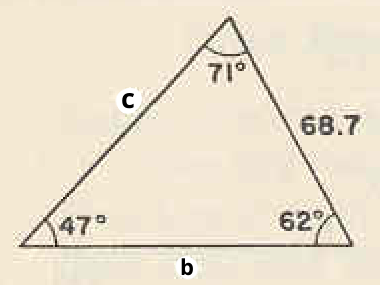
Basically, if some or all of the angles are given, opposite parts on a triangle are set opposite on the side rule.5 Here is the Law of Sines,
\[\frac{\sin{A}}{a} = \frac{\sin{B}}{b} = \frac{\sin{C}}{c}\]
However, on the slide rule, this is what we are doing,
\[\frac{a}{\sin{A}} = x, \quad \frac{b}{x \sin{B}} = \frac{c}{x \sin{C}}\]
If we set sine 47o opposite 68.7 on the D scale, we can then slide the HL to sine 62o and read c = 82.9 on the D scale. Further we slide the HL to sine 71o and read b = 88.8 on the D scale. Aligning the first number/sine combination is setting the ratios for the remaining values. We then multiply that number by each sine to determine the remaining values. If not all angles are given, the total must add to 180o.
The same methodology applies for a right triangle. Using A = 42o and a = 74, we know C = 90o, so B = 48o. Setting sine of 42o opposite 74 on D scale and sliding the HL to sine of 48o gives 82.4 on D scale. For c, we could use Pythagoras’ Theorem, or we could look at the left index for 110.8, as the 90o index is off the right side.
References
Footnotes
Some images are made using a Pickett N600-ES virtual slide rule as I don’t have a K&E Deci-Lon virtual slide rule.↩︎
As a reference, \(\pi\) to 21 digits is 3.141592653589793238462.↩︎
The three trigonometric scales, T, S and SRT scales are slightly extended to ease transition from one scale to the others.↩︎
If we wished to convert the ft2 to m2, without moving the HL, slide B scale 13 under 140 of the A scale, then read 65.2 m2 under the HL opposite 702 ft2.↩︎