Transit Hobby
One of the things about being retired is the ability to enjoy hobbies! In fact, having hobbies is pretty much a requirement to really enjoy retirement!
Having as one of my hobbies survey transits, it follows that the ones I have collected can also be used for real projects, not just collected. This results in the enjoyment of using and adjusting various transits I have acquired over the years. Adjusting a transit is a great way to learn how that particular model works.
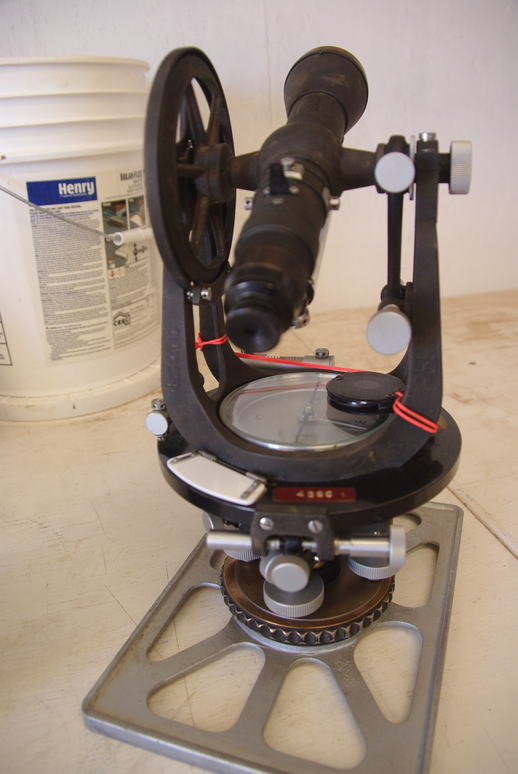
The Lietz #550 was one of the first transits I acquired, the so called American Transit, Engineer Transit, or just vernier transit. Of the two I have (the other is a Texas-Asiatic), both use the older-style mount of 3 1/2 inch diameter by 8 threads per inch. It consists of both vertical and horizontal circles, each read by interpreting a vernier scale to the nearest 20 seconds. It takes some skill and good magnification to determine which lines match up on either scale. Both sides of the scale are read (A side and B side) to eliminate any eccentricity of the circle. Also handy is the built-in 360o magnetic compass.
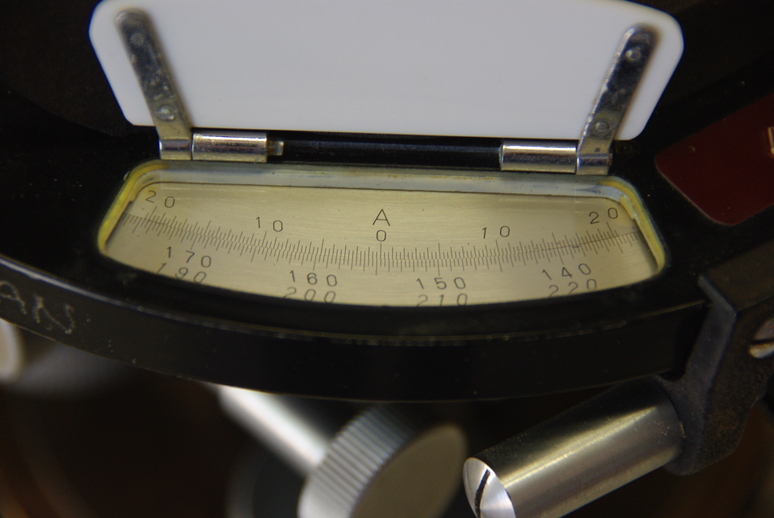
This image shows a reading of 154o42’20“ counterclockwise, or 205o17’40“ clockwise. Reading the line that matches up perfectly needs a strong magnifier, especially for older eyes like mine! It’s kind of fun and I once used it to lay out a building, specifically to determine where the corners went exactly, and determine if it was square. Even with this almost 100 year old work of art, it is possible to get within less than 1/16th of an inch vertically or horizontally. Obviously, this assumes the instrument used is in adjustment. And that is a great part of the fun, adjusting! Any good older surveying book usually has procedures on how to make adjustments. The specific user manual for a transit is the best place to look for particular procedures and can usually be found with a search if the manual is not included with the instrument.
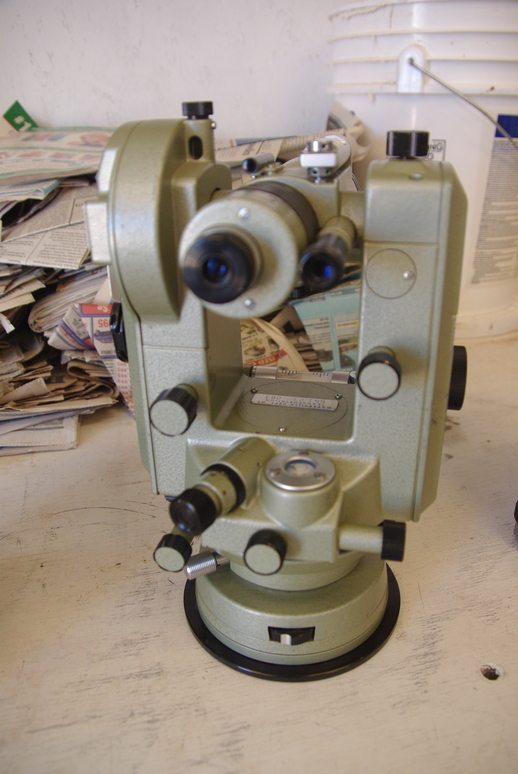
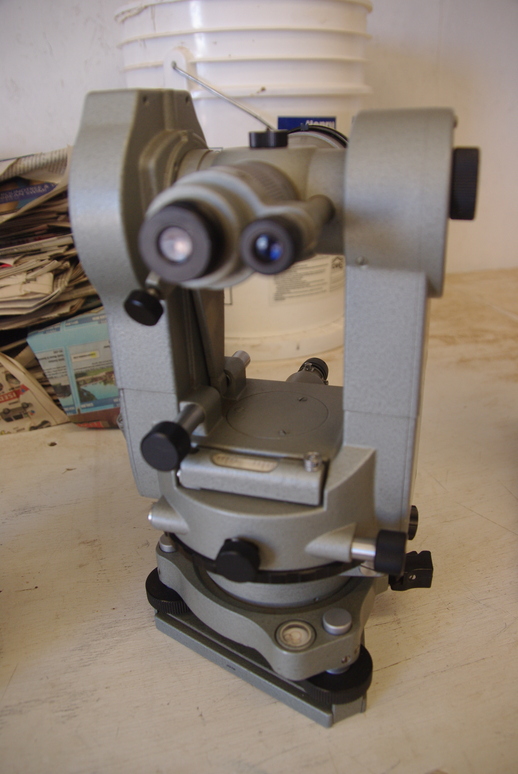
The Pentax TH10 was branded under several names, one of which was the “Geotec” brand. I have been unable to find any information on that particular brand although several have recently been offered on E-Bay. Anyway, it uses internal micrometer scales etched on glass and directly reads to 10 seconds. It has become one of my favorites to use because it is fun to setup, level and take a reading. It has for the vertical compensator a split-bubble scale that is adjusted to match up opposite ends of the bubble. The reading in the below image is not compensated. However, for both the horizontal and vertical readings, the adjustment knob would be turned so as to place the vertical line between the two degree lines, then the degrees, minutes and seconds would be read from a combination of the V or H and the lower minute/second scale. For the V scale, the split-bubble view would be first adjusted to match the two ends in a viewing prizm, then a reading taken.
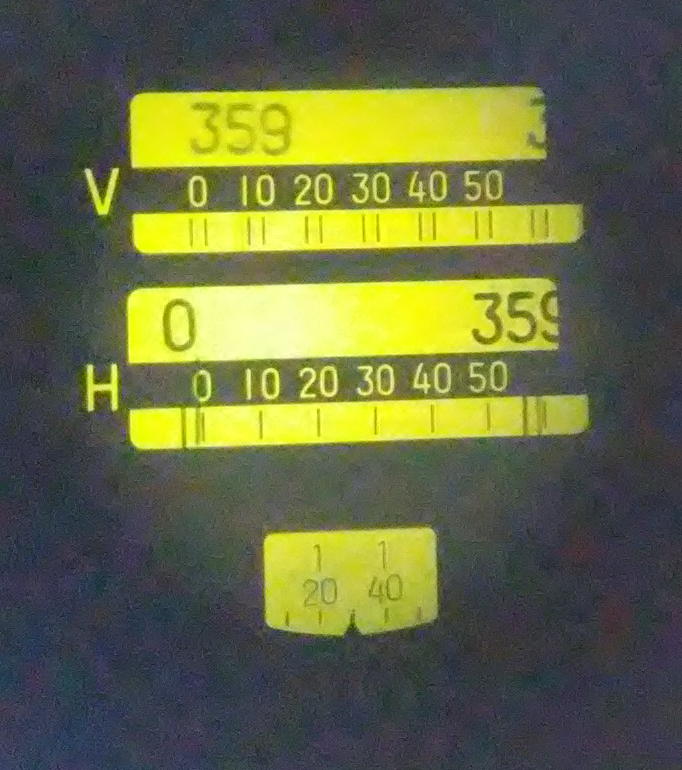
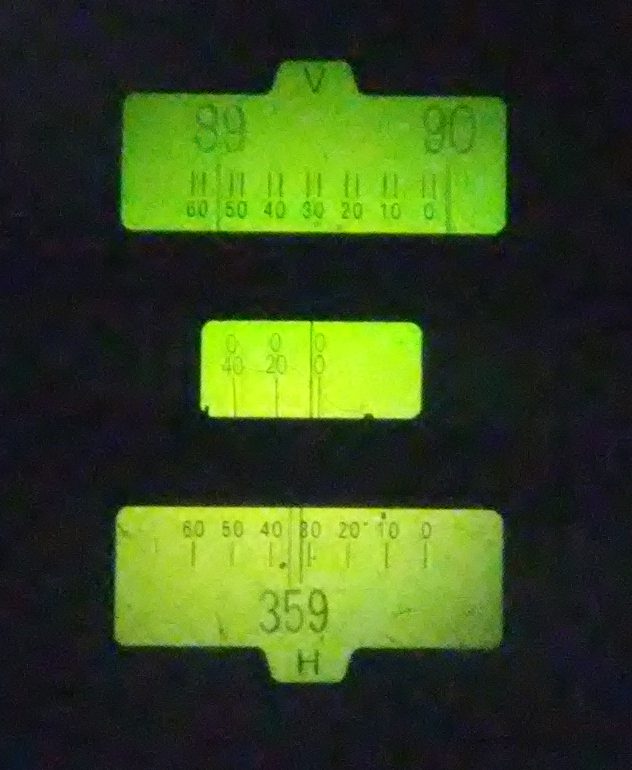
The Lietz/Sokkisha TM20C is another theodolite similar to the Pentax TH10, but only reads directly to the nearest 20 seconds. It uses an internal vertical compensator for vertical readings, so doesn’t require matching bubble ends. However, it does require a light tap to free the compensator before reading the vertical angle.
The process for the TM20C is the same as reading the Pentax, except the minute/second scale is between the vertical and horizontal scales.
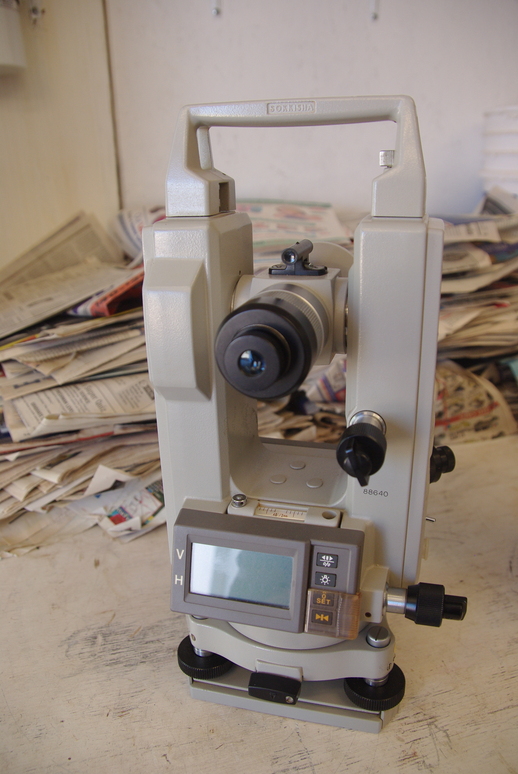
The Sokkisha DT5A Digital Theodolite below is electronic and requires a battery pack for operation. Functionally, it is similar to the above two theodolites but is a “direction theodolite.” This means that instead of an upper and lower movement like the vernier transit and optical theodolites above, it has only one horizontal movement and cannot be used as a “repeating” theodolite. The plus side is it is more accurate than the above instruments. Vertical indexing is accomplished by rotating the telescope on the horizontal axis through a complete turn, which sets the vertical level. Functions exist for setting horizontal zero or an offset angle. Slope percentage can also be selected.
All these transits and theodolites perform the same functions, but work in slightly different ways. That is part of the fun, not only using older survey instruments, but also rescuing them from the dustbin of history and reviving them before they are gone forever. Nowadays, most professional surveyors use total stations consisting of a combined theodolite and electronic distance measurement (EDM) instrument, or even Global Navigation Satellite Systems (GNSS) as the primary means of data collection. This field has come to be known as “Geomatics” and primarily uses satellite navigation systems such as the US Global Positioning System (GPS) satellites, the Russian GLONASS, the EU Galileo or China’s BeiDou system. All of this is to reduce time and costs for the professional surveyor and increase accuracy for the survey.
I hope you enjoyed this little dissertation into older survey instruments. Perhaps you too will be caught up in the fun of the hobby such as I.
We thank God for the ability to entertain this hobby and continually look to Him for guidance in all things. And, remember, it doesn’t have to be expensive to acquire good older instruments from places such as E-Bay. Just ensure you do your research and ask questions and look carefully at what’s offered for sale before bidding.
Till next time… and stay safe!