Surveying and EDMs
Having recently acquired a Sokkisha RED2L Electronic Distance Meter, I am now learning a lot about using an EDM and some of the challenges involved. For example, there are many parameters a person needs to be aware of when using the EDM to measure a distance, such as the temperature and barometric pressure at the site location. These affect the actual distance acquired on the EDM in the form of the ‘parts per million’ of the measuring frequency. This, in addition to the accuracy specification of the instrument itself will give a plus or minus possible error range that must be taken into account when assessing the accuracy of the measured distance. If not adjusted for those values, the distance may be off a significant amount. The RED2L has a constant error of ±5mm and scalar error of ±5mm at ‘normal’ atmospheric conditions. The formula to determine the magnitude of instrument and target error \(E_d\) is:
\[E_d = \sqrt{E_i^2 + E_r^2 + E_c^2 + (ppm \times D)^2}\]
where \(E_i\) is the estimated miscentering error in the instrument, \(E_r\) the same for the reflector, \(E_c\) the specified constant for the EDM, ppm the scalar error and D the measured slope distance. For short distances the constant is the determining factor, whereas the scalar error determines errors for longer distances. The RED2L should be able to read to 15,000 feet (4600 meters) with a single prism, which is what I have.
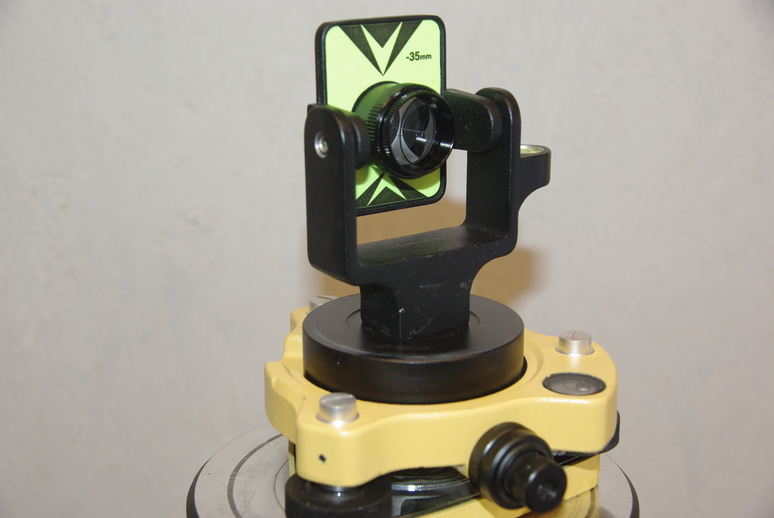
Another significant factor is the prism itself. On the EDM, an adjustment must be made to balance the prism offset. For example, if the prism being used has a negative offset (reflector constant) of -35 mm, then the EDM electrical center must be moved forward to compensate. Otherwise, depending on the distance measured, the reading may be off by a foot or more. The RED2L adjusts in 10 mm increments.
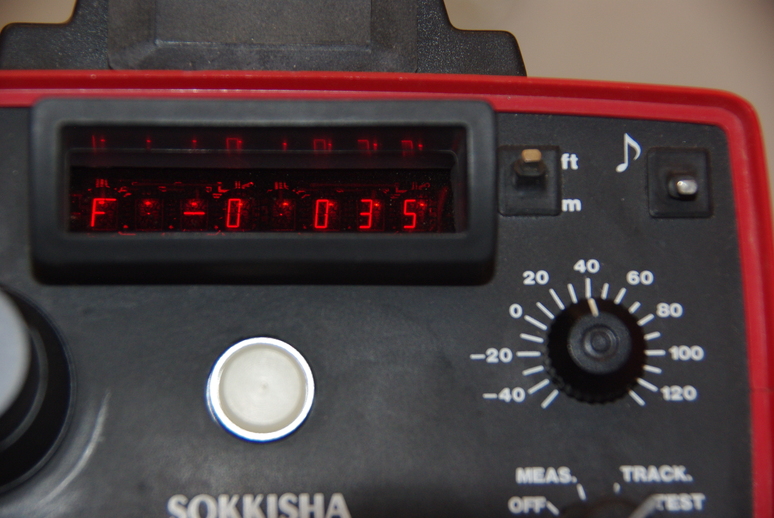
After determining the local conditions (pressure (P) in inchHG and temperature (F) in degrees), the dial is set to that PPM value. The formula to determine the PPM value is
\[PPM = 278.96 - \frac{10.5 * P}{1 + 0.002175 * F}\]
The EDM I have can currently only be mounted on the Sokkisha DT5A theodolite as different mounting brackets are needed to mount it on the Sokkisha TM1A, which is where I want to eventually use it. The reason is the DT5A digital readout reads to 10 seconds whereas the TM1A reads directly to 1 second, and by estimation to 0.1 second.
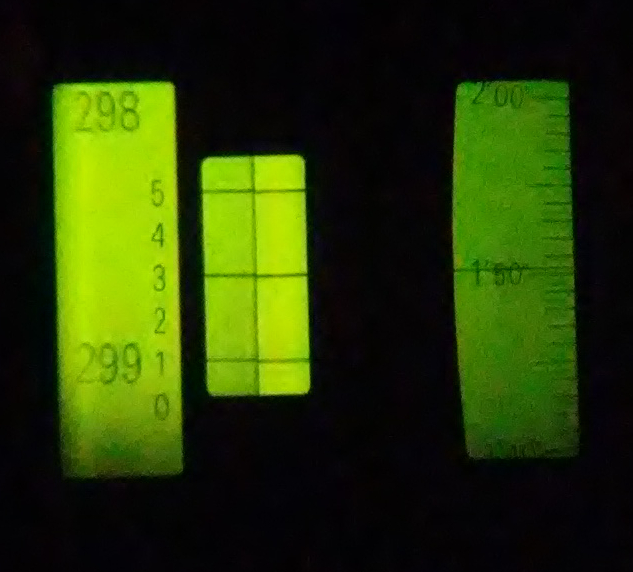
Both those figures imply direct and reverse readings are taken in several sets to obtain an average reading. This is necesssary to reduce or eliminate operator and instrument errors for any theodolite.
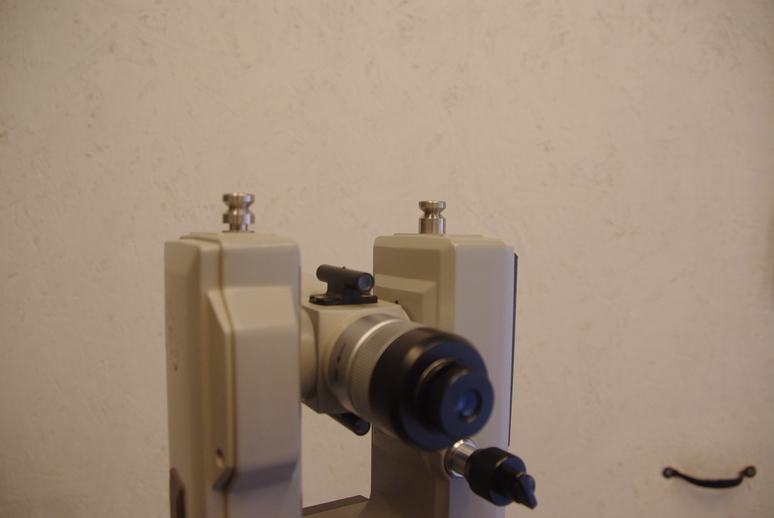
Removing the handle on the Sokkisha DT5A exposes the two posts for the mounting brackets of the RED2L. Once in place, the EDM bracket adjustment knobs align the EDM with the retroreflector. The theodolite is already pointed to the target, which may be the reflector or another target.
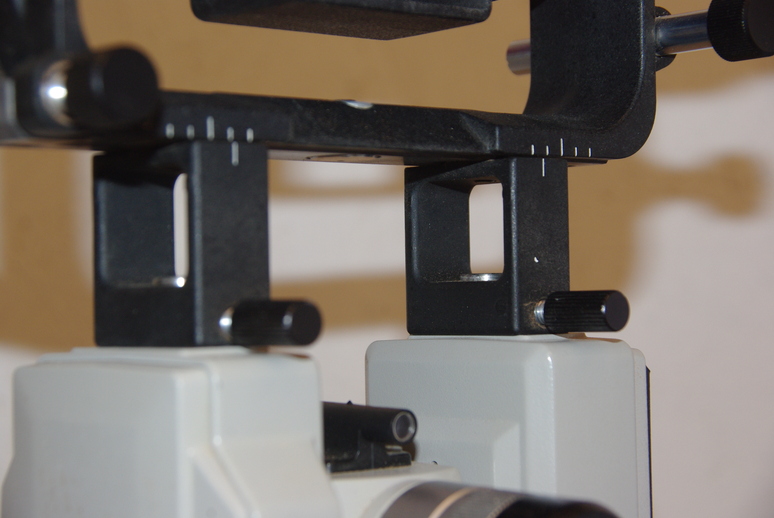
It is simpler to use the retroreflector as the target for both as it is easier to calculate the distance versus angle issue. This is necessary to determine both the actual horizontal distance and difference in height from the station to the target. Multiple angles are involved; instrument height, EDM height, reflector height and target height (if different from the reflector). The correct angle, of course, is the theodolite to target angle. However, the distance is calculated from the EDM, which is mounted a short distance above the telescope. This gives a very small angle difference which must be taken into account. Also, as mentioned above, if the theodolite is pointing at a different target from the retroreflector, that angle must also be considered, and the distance adjusted.
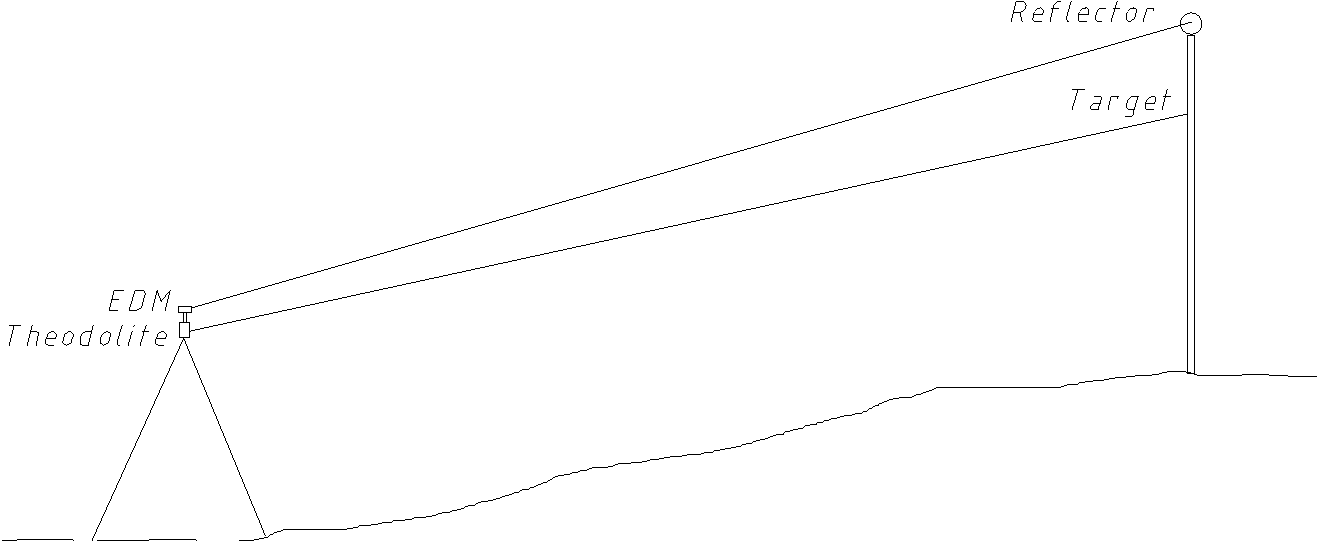
The procedure to correct the distance in this case is similar to another procedure to correct angles for offset stations (eccentric stations) where a desirable station is inaccessible, but that’s another subject. The formula for this reduction is
\[H = \frac{\Delta H \cos \alpha}{D \times arc 1^{"}}\]
where \(\Delta H\) is (reflector height - target height) - (EDM height - theodolite height), α is angle, D is distance, and arc 1˝ is 0.0000048481. Arc 1˝ is calculated with \(2 \pi r \times (1^{"}/360^\circ)\). I have the theodolite set where 0° is at zenith, so I subtract the angle from 90. What makes this all simple is I have programmed my trusty Casio Prism calculator to do the “heavy lifting.” And, since I like using “R” on the computer to see what it can do, I also wrote a simple program to do it there too! I also decided to do the same thing using C++ since I haven’t used it in a while, and figured this would be the perfect opportunity to become reacquainted.
Another set of formulas from the Sokkisha RED2L manual for determining distance and height using just the theodolite/EDM and a reflector prism (without the separate target) is shown here.
\[Distance = (d * \cos(\varphi) + \sqrt{D^2 - d^2 \sin^2(\varphi)} ) \sin(\varphi)\]
\[Elevation = h + (d * \cos(\varphi) + \sqrt{D^2 - d^2 \sin^2(\varphi)} ) \cos(\varphi)\]
where ‘d’ is theodolite/EDM height difference (DT5A/RED2L is 0.625 ft or 0.1905m), ‘D’ is EDM distance reading (compensated), \(\varphi\) is Zenith angle (\(0^\circ\) is up), and ‘h’ is theodolite height. The elevation formula includes reflector height, so for altitude difference, subtract reflector height from result.
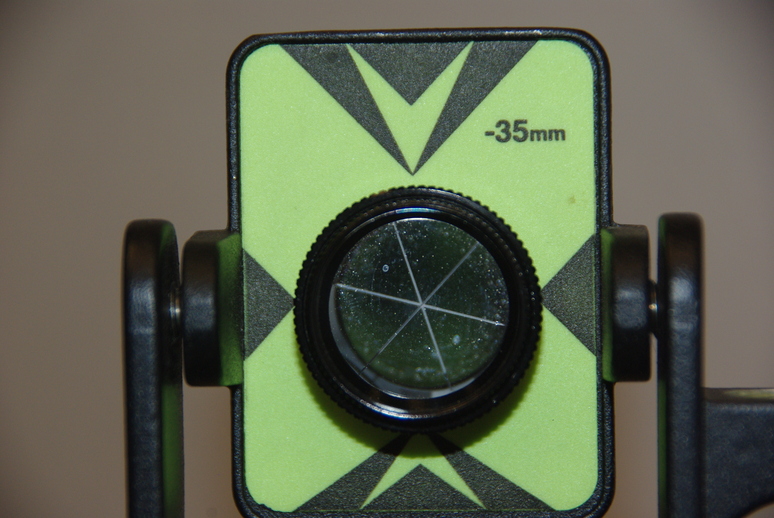
Here is a closeup of the prism, in need of cleaning. Printed on the target is the offset (reflective constant), which in this prism is behind the zero point. The zero point, of course, should be directly over the target station. Because light travels slower in glass than air, the effective center is actually behind the prism. The index of refraction of glass is approximately1.517. As mentioned above, not setting the offset on the EDM may result in a large distance error!
We thank God for all things we have, and we ask for guidance in all dealings with others so that we may be a blessing and not a hinderance. We pray that you too will come to know God’s Grace and Love through His Son Jesus. In fact He loves us so much He sent His only Son so that we may come to know His plan for our lives, and that by accepting Jesus as our Savior, we may partake of His blessings and His Love eternally. He does not wish to lose a single soul, but YOU must make the choice. Stay safe this Holiday season and WEAR YOUR MASKS if you are out in public! God Bless you and yours!