Slide Rule Mania
Today is a Snow Day! Weather is not the best for outdoor activities, so I thought I’d just throw out some more slide rule stuff! Yay! Or not…
I was reading through the Fiesenheiser (1951) slide rule book acquired about 10 years ago, and the section on logs caught my eye. Specifically the part where the slide rule is used to determine logs to any base, and the like.
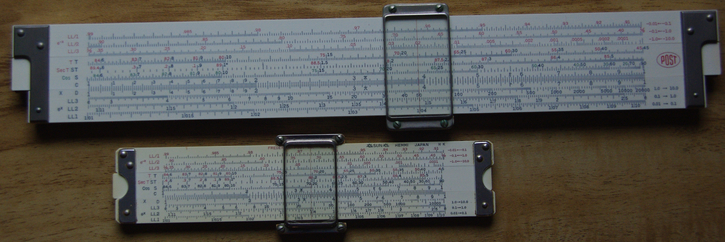
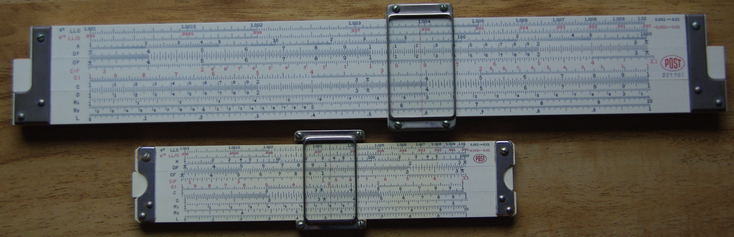
Funny how the Lord works, because I just recently acquired a couple of Post Versalog slide rules, a 1460 and a 1461. Afterwards, I realized I already had the book for that very rule. Admittedly, during that period, I was collecting all the slide rule books I could find. So today I finally managed to determine the manufacturing dates for both rules.
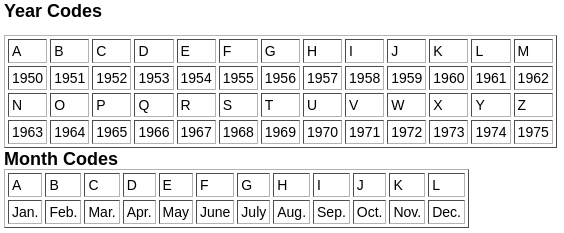
The full-size 1460 has the date code LJ which is October 1961; the smaller 1461 the date code HK, for November 1957. Nice to know!
Anyway, on to the subject…
Log-Log Scales
I don’t recall if, in earlier posts, I had mentioned much about the LL/-LL scales on the Versalog, or any other slide rules, such as the Pickett rules, my particular favorites.
Anyway what’s nice about these scales is the decimal point is usually given by the scale reading, making it unnecessary to determine its location. But, it is necessary to ensure the actual reading, as the scales subdivisions change frequently. This is caused by the large range the scales cover, usually from about 0.00005 to a bit over 22,000. The numbers on the log log (LL) scales represent powers of e. All the LL scales are on the body, as is the D scale, so the powers can be read by simply setting the hairline (HL). So, if x represents a number set on the D scale, the value of ex is found on the LL scales. The LL0, LL1, LL2, LL3 are positive scales (i.e., ex), and LL/0, LL/1, LL/2, LL/3 scales (or -LL0, -LL1, -LL2, -LL3) are reciprocal scales for negative powers (i.e., e-x).
For logs to arbitrary bases we have the form of \(\log_{x}{N}\), where almost any value can be used and calculated. One thing to remember, if the N value is less than 1, the decimal in the answer is moved left one place from the range indication on the slide’s LL scale range.
So, let’s set up one example to show the scales. Presume we wish to determine the result of the totally made-up calculation as so,
\[A = \frac{\log_{11}{34}}{\log_{7}{17}}\]
This means the log to base 11 divided by log to base 7. This will require separate actions to determine the final answer. First we can find the values as such. We set the C index to 11 of the LL3 scale, then slide the HL to 34 of the same LL scale, and find 1.47 on the C scale. Next, to find the second value, we set the C index to 7 of the LL3 scale, slide the HL to 17, also on the same LL scale, and see the value of 1.455 on the C scale. Note the result value is determined by the LL scale used, where the range is printed at the right end of the appropriate LL scale (For LL3 the range is \(1.0 \rightarrow 10.0\)). Below are the two setups for the above example.
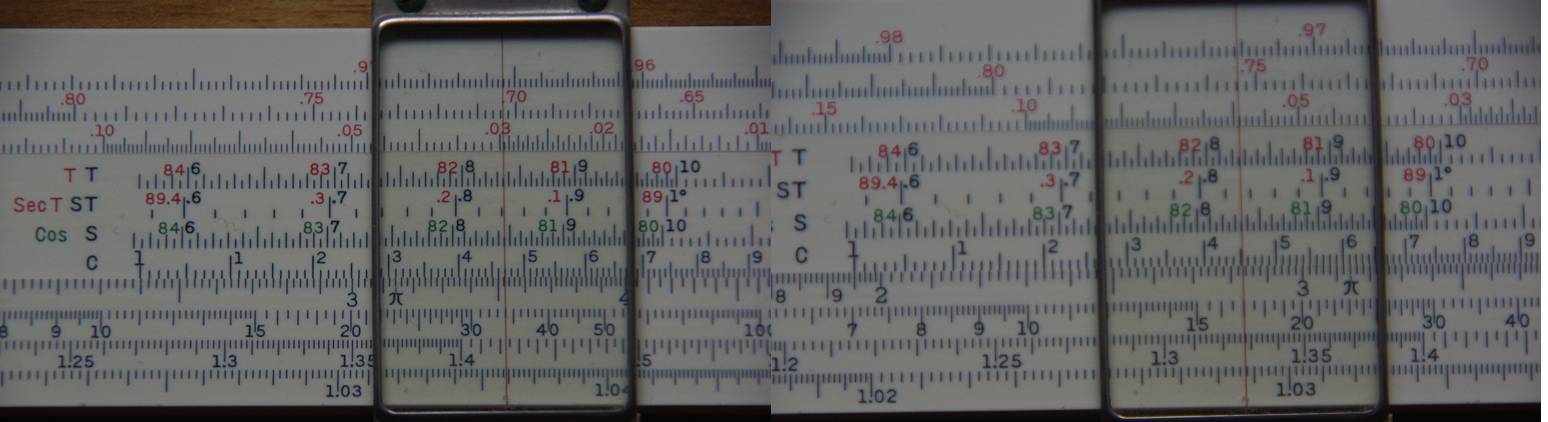
The left image shows the index aligned with 11 on LL3, the HL set on 34 of LL3, reading 1.47 on the C scale. The right image has the index at 7 of LL3, the HL at 17 of LL3, showing 1.455 on the C scale. So we now have the values 1.47 and 1.455, which we determine by the usual division, using the C and D scales.
\[A = \frac{1.47}{1.455} = 1.01\]
By the way, if you have a formula, \(A = log_{x}{N}\), where the base (x) is the same as the value (N), the answer will always be 1. And as mentioned earlier, any number on a LL scale has its reciprocal on the same numbered -LL scale. Another example producing negative values might look like this,
\[B = \frac{\log_{0.4}{13}}{\log_{35}{0.12}} = \frac{-2.799}{-0.598} = 4.69\]
We find the first value by setting the right index to 0.4 of the -LL2 scale, the HL to 13 of the LL3 scale, and read -2.799 on the C scale. Next we set the right index to 35 on the LL3 scale, slide the HL to 0.12 on the -LL3 scale, and read -5.98 on the C scale. We move the decimal left one place as the N value is less than 1 for -0.598. Normal division gives the final result of 4.69. Remember that if we multiply or divide same signed numbers, the answer is positive.
And that’s it for this post. Have a great day in the Lord Jesus Christ, The Word.1 Once again, Happy Holidays, and God Bless you and yours!
References
Footnotes
First John 1:1 That which was from the beginning, which we have heard, which we have seen with our eyes, which we have looked upon, and our hands have handled, of the Word of life.↩︎