Slide Rules and Decimals Part 2
Recently I posted a little bit on locating the decimal point for slide rule results. I think I may expand on that with some examples, more for my edification than any other reason.
Let’s take an example that may not be very realistic in the real world, but will serve for this purpose.
\[\frac{35 \times 0.0000455 \times 123 \times 0.01}{0.005 \times 11 \times 40^{2} \times 0.000000000025}\]
Historically, in older books and manuals, the last number on the bottom left would be stated as micro-micro instead of pico, or noted as \(25e^{-12}\). However, we will use it as noted in the diagram below.
So, how do we do this? Firstly, let’s determine the digit/span value for the above.
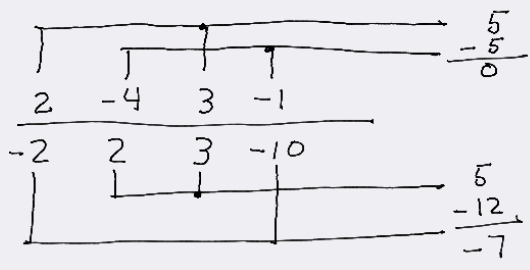
Notice I used three for the third bottom value, as 402 gives three digits. So before we determine what the slide directions may add to the above, we explain how to note these by placing a superscript “R” by the number if a multiplication, and subscript “R” by the number if a division, to keep track when the slide projects to the right. We will use only the C and D scales for simplicity.
Now we will perform a combined operation (i.e., cross-multiply and divide) to determine the final value and the digits/spans. We slide the hairline (HL) to 35 (D scale), move the 5 (C scale) under the HL. We slide the HL to 455 (C scale), slide 11 (C scale) under the HL (slide to right), move HL to 123 (C scale, slide to right), slide 160 under HL. As the last top digit is a power of 10, we skip that value so the slide doesn’t move, and multiply by the reciprocal of 25e-12. We could use the CI scale and set 25 under the HL, and read the final value of 890 (D scale) at the index. Or, we could divide by the reciprocal of 25, and set .04 (C scale) under the HL, still using only the C and D scales. The result would again be at the index (890). If we did use the 0.01, we move the HL to the index, then slide 25 (C scale) under the HL, giving 890 (D scale) at the index.
\[\frac{35 \times 0.0000455 \times 123^{R} \times 0.01}{0.005 \times 11_{R} \times 160 \times 0.000000000025}\]
For the logic, we use 0 - (-7), which gives us 7. However, by multiplying by the reciprocal of 25 we have the equivalent to a CI scale extending to the left, which subtracts 1. So, the 7 becomes 6, and this gives the decimal placement of the final answer, for a result of 890000. If we had included the 0.01 multiplication (and the divide by 25), the slide would protrude to the right, again subtracting 1 from the total, still giving 6.1
For this next example, it will actually be easier not to cross-multiply and divide.
\[\frac{25^{R} \times \sqrt[3]{27} \times 0.0025}{147_{R}}\]
Here, since we are using the Post 1460 slide rule which has a K scale on the body, we can start with the middle value to find the cube root first. Set the HL to 27 (K scale), slide index under the HL(slide to right), move HL to 25 (C scale), move right index under HL, slide HL to the second 25 (C scale), then slide 147 (C scale) under HL (slide to right), read 1275 (D scale) at index.
I already noted the slide orientation in the above example. So the logic is 3 - 2 = 1. The two “R” values cancel, so we have 1 - 3 = -2, so we add two zeros to the answer for 0.001275.
Whew! Was that fun or what? And of course, once again we have the reason handheld calculators replaced the slide rules so quickly! If I do any more ruminations about slide rules, I may try the K&E Deci-Lon versions, the 68-1100 (10”) and 68-1130 (5”).
So, Happy New Year! God Bless you and yours!
Footnotes
The included diagram was drawn on the reMarkable 2 tablet using a whiteboard program on the computer.↩︎