Logs On The Fire
I suppose the title of this post may seem a bit misleading, but it does actually fit. One, the weather is COLD, 17o F this morning. I do admit that is not really that cold as it has been colder this month, but the wind is fierce. Two, I intend to address a little bit about logarithms on slide rules.
Finally, I have in my hand, the K&E Deci-Lon 5, the 68-1130 slide rule! Woo Hoo! This is one of the slide rules I have been attempting to acquire since around 2016. However, I will admit there was a 8-year gap in my interest in slide rules, as there were a great many things going on that were more important. So, I was just too busy to be involved in slide rules. Now however I again have time to play with them, and I do mean play. Nothing serious, you understand, just pleasure.
Anyway, having actually written all that rhetoric, I now continue…
I may have mentioned in previous posts about doing something with this particular slide rule, and here it is! This time I think I will explore a bit with logarithms, natural and common. The K&E Deci-Lon has the usual four sets of scales, called Ln 0, Ln 1, Ln 2, Ln 3; and their reciprocals, Ln-0, Ln-1, Ln-2, Ln-3.
One addition I like about the Deci-Lon is the return of the A and B scales. In earlier posts, I had lamented about the lack on some rules, such as the Post Versalog, of those scales. Although most of the rules lacking those two scales usually have square root (Sq1, Sq2) scales to compensate. However, the Deci-Lon has both sets, adding to the versatility.
I was a bit disappointed to find \(\pi\) symbols on only one set of C/D scales, not both. Seems a bit strange, as one side has both \(\pi\) and \(2\pi\) symbols, but the other has none. The color coding for the different scales are consistent, however, including the slide itself; red for the “back” side and black for the “front.”
I think I will start by including the images of the rule.
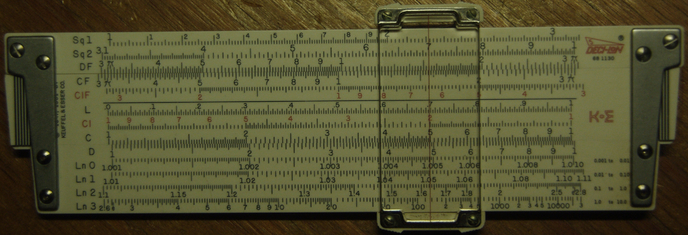
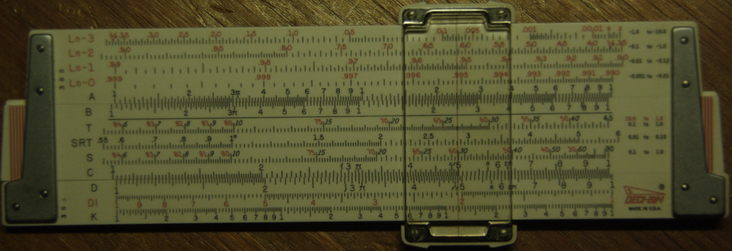
What’s nice is the stock was made wide enough to fit all the LL scales on each side, the positive LL scales on the front and the -LL scales on the back. That was one thing I found annoying about the Post Versalog. Even though both slide rules have the same scales, the Post had the LL0/-LL0 on the opposite side from the others.
Also a K scale on the back for cube roots is handy, as is the DI scale on the body, allowing quick reciprocals of D scale readings. So the bottom line is simply that it has all the usual scales, but with the reintroduction of the A/B scales.
Now, down to business. Sorry, I mean play! Really! Something about firewood, or was that logs?
Another day, and two inches of snow, and it’s still accumulating. One of the perks of living deep in the mountains. So a good excuse to continue this.
As I mentioned earlier, I like the fact K&E placed all the LL scales on the same side of the rule. The only downside to that is it makes it necessary to flip the rule to see the reciprocal. What’s the old saying? You can’t have your cake and eat it too!
The first example I want to use is deciphering the catenary formula, which requires the hyperbolic cosine, using the LL scales of course. Our two formulae, for length and sag,
\[L = 2 \frac{H}{w} \sinh{\frac{w b}{H}} \quad and \quad S = \frac{H}{w} \left(\cosh{\frac{w b}{H}} - 1\right)\]
where H is tension at the lowest point, w is weight per feet of chain, rope or cable, b is 1/2 total span. Other recent posts on this subject are here and here.
Let’s use an example from K&E (1962), page 108. Here we have H = 26 lb., w = 2 lb/ft, and b is 30 ft.
\[L = 2 \times \frac{26}{2} \sinh{\frac{2 \times 30}{26}} \quad and \quad S = \frac{26}{2} \left(\cosh{\frac{2 \times 30}{26}} - 1\right)\]
Some preliminary work in our heads will make this easier. 26 / 2 = 13, 60 / 26 = 2.31. So we then have,
\[L = 2 \times 13 \sinh{2.31} \quad and \quad S = 13 \left(\cosh{2.31} - 1\right)\]
The two hyperbolic functions, \(\sinh{x} = \frac{e^{x} - e^{-x}}{2}\) and \(\cosh{x} = \frac{e^{x} + e^{-x}}{2}\) we can determine first. Setting 2.31 (D scale) shows 10.07 (Ln3 scale) and its reciprocal, 0.099 (Ln03 scale), giving \(\sinh{2.31} = 4.99\), and \(\cosh{2.31} - 1 = 4.09\). Now we simply multiply,
\[L = 2 \times 13 \times 5 = 129.4 \quad and \quad 13 \times 4.09 = 53\]
That seems a bit long, but with practice is fairly straightforward. Some numbers I rounded for clarity. As can be seen, using the LL scales is pretty simple. And for completeness, here is the other hyperbolic formula, \(\tanh{\frac{\sinh{x}}{\cosh{x}}}\).
And just for fun, let’s throw in another calculation, 120.5, which looks like this,
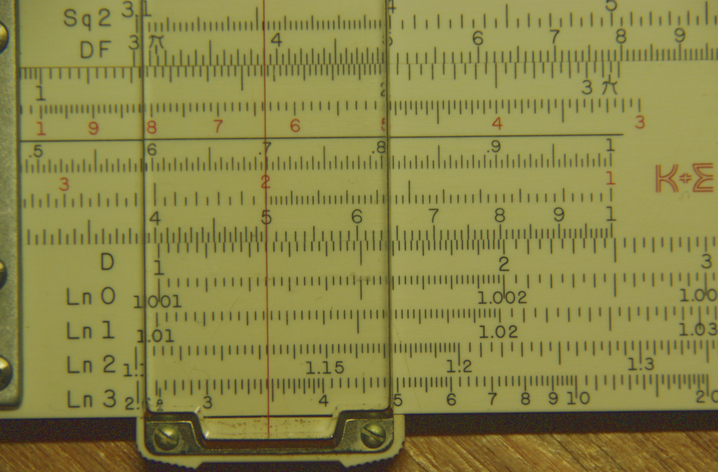
We set the index aligned with 12 (Ln3 scale), slide the HL to 5. Reading the same scale, we see 3.46, or \(2\sqrt{3}\).
Common logarithms are pretty straightforward too. The normal L scale is on the slide, so is most easily used with the C scale. I won’t belabor this subject, as it is pretty basic. Suffice it to say the mantissa is under the HL opposite the C scale number, and the characteristic is one less than the number of digits in the number (i.e., \(\log{245} = 2.389\)).
And that’s enough eye-glazing for one time!
Have a great day! God Bless!