Frequencies
Today is a Snow Day here in the mountains (hopefully for the next three days!), so I thought I might attempt to post a bit about piano frequencies and rocks!
What? What do rocks have to do with pianos? The straightforward answer? Nothing! Unless you consider the piano plate, which holds all the strings under tension and may weigh 150 - 500 lbs. It is made from cast iron and could seem like a large rock if you wished to move it. The plate is sometimes erroneously called the soundboard, which actually is a thin piece of wood on the bottom or back of the piano that magnifies the string sounds.
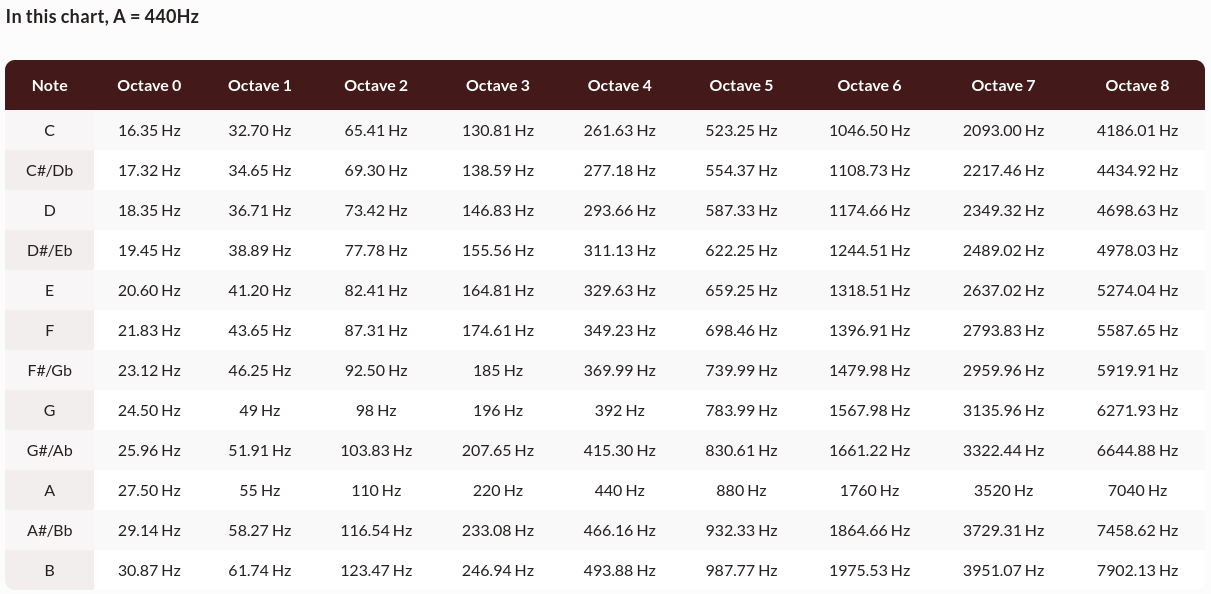
Looking at the above chart, notice in octave #4 the Middle C frequency of 261.63 Hz. The reference frequency for most musical instruments is 440 Hz, the A4. This chart is useful mostly for luthiers and others that construct musical instruments. A normal 88-key piano keyboard has at the lower end the A0 (27.50 Hz), and at the upper end, the C8 (4186.01 Hz), for a total of eight octaves. Each octave has the notes A through G.

The above keyboard is the VMPK1 found here. Does that rock, or what? Oops, there’s that word again…
This brings up the premise that rocks may be fractured or moved using ultrasonics, microwaves, or other means. Various methodologies have been suggested in the past, mostly in conjunction with oil or gas exploration, or excavation in areas where explosives are not viable, such as in suburban areas for pipes or other underground excavation, where minimal surface disruption is desired.
Ultrasonic vibration technology is a method for breaking hard rocks. It utilizes high-frequency sound waves, typically above 20 kHz, to create resonance within the rock. This resonance significantly weakens the rock’s structure, allowing it to fracture more easily. The frequency may be tailored to the type of rock to be affected, one method known as *Resonance Enhanced Drilling (RED).
Another method receiving strong pushback from organizations concerned with health and environmental side effects, is hydraulic fracturing, also called fracking, as these methods usually affect existing ground water reserves and aquifers, by injecting chemicals into the ground strata.
At the other end of the spectrum, are websites suggesting other, more ancient methods for manipulating rocks, etc. For example this website explores more esoteric methods.
However, what would be really handy is a methodology such as the following. Suppose there was a device using a directed beam of energy, confined and manipulated by magnetic fields, that dissolved or disrupted the rock strata while simultaneously forming the displaced rock into a condensed lining for the same excavation, thereby supporting the cavity walls, and greatly reducing the heavy equipment required for installation of lining or support structures.
Applications could range from mineral exploration to housing in otherwise inhospitable regions. This concept could alleviate or minimize the risky endeavor of requiring excavation shoring for already weakened tunnel or cavity walls from drilling or blasting.
Anyway, that’s all for this rabbit trail into the possible or marginally useful and we hope it was enjoyable. Have a great day, and may the Lord Bless you and yours!
Footnotes
The Virtual MIDI Piano Keyboard is a MIDI events generator and receiver.↩︎