I was reading a book the other day called “The Joy of \(\pi\)”, (Blatner 1997), which had a section on “Circle Squarers” who, throughout history, have attempted to square a circle, where using only a straightedge and compass, convert a circle into a square having the same area. This is without the benefit of knowing the value of \(\pi\), or refusing to admit that \(\pi\) exists at all, as a transcendental number.1\(\pi\) is known as irrational, because it can’t be expressed as a ratio of integers.2 Folks over the history of mankind have attempted to obtain the final value of \(\pi\), and have calculated 5.15x10¹⁰ digits as of 1997.3 That’s 51,500,000,000 digits, and still counting.
However, the records continue to be broken. Again, Dr. Kanada calculated over 206 billion in 2002. Then, in October 2011, Shigeru Kondo bettered his own August 2011 record of 5 trillion digits by calculating 10 trillion digits!
It seems like such a simple problem. Draw a square that covers the same area as a circle, using nothing but a straightedge and a compass. How hard could that be? (Blatner 1997)
Well, this is called the quadrature of the circle. It is really quite easy these days to do that very thing. However, the ancient Greeks added two conditions:
Use only a straightedge and a compass.
Without using an infinite number of steps.
Over time, it has been proven as impossible. But that has not slowed the “Circle Squarers” from attempting to prove their particular solution as fact. Many, in past times, spent years trying to do that very thing, with no success. Some have come up with their own version or rationale as how to do it, with irrefutable proof, of course. None have survived the proof of mathematical rigor.
All this is because I have been playing around with various slide rules lately, and decided to show how really simple it can be to do the above, using the value of \(\pi\) in commonly accepted formulas of today. Those simple formulas are the area of a circle,
\[
A = \pi \times r^{2}\]
The circumference or perimeter of a circle,
\[P = \pi \times D\]
And the area of a square,
\[A = side^{2}\]
On a slide rule, as on a calculator, the conversion is simply,
\[Side = \sqrt{\pi \times r^{2}}\]
Giving the length of the square’s side. Simple enough using \(\pi\), impossible using mechanical means only. However, like many enthusiastic (or should I say fanatic) people, they continue to attempt to prove their particular form of insanity. Sort of like those that still think the Earth is flat!
Many people, just for the fun of it, memorize lots of digits of \(\pi\), for the entertainment value, among other reasons. I have stopped at 21 digits for my own enjoyment, and don’t intend to try to remember any more. And that is 3.141592653589793238462. FYI, 20 digits totals 100.
But many aspire to calculate more, looking for some pattern, or perhaps, the “Theory of Everything.” Just as a point of fact, the NASA JPL scientists and engineers use only 15 digits in their calculations. To put this in perspective, calculating the circumference of a circle with a radius of 12.5 billion miles,4 the error using 15 digits of \(\pi\) is only 1.5 inches. Even using the size of the visible universe with a radius of 46 billion light years, you only need about 40 digits to calculate the circumference with an accuracy of the width of a hydrogen atom.
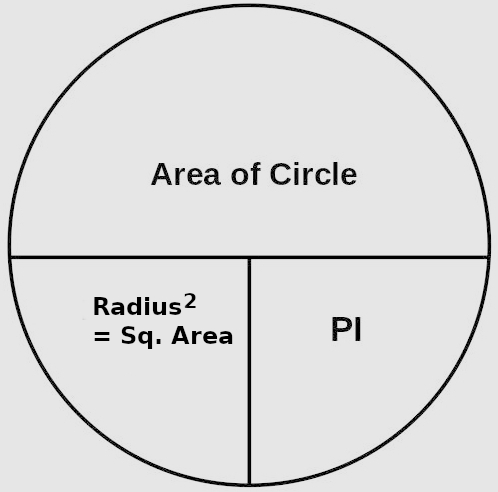
Another little tidbit: \(\pi\) is the ratio of the circle to the square, where one side of the square = \(\sqrt{area_{circle}}\). What that means is for a square where one side is the same as the radius of a circle, the circle’s area is the square’s area times \(\pi\). The below image shows the circle formulas graphically.
Another bizarre fact: the first 144 digits add up to 666, the biblical “Mark of the Beast.”5
Hope you enjoyed this little excursion into ‘oddities’ as much as I have. For more interesting facts, visit The Joy of PI website.
If you wish to determine particular digits of π for your own satisfaction, you can use a class of algorithms known as BBP Formulas (named after Bailey-Borwein-Plouffe). These are digit-extraction formulas, which means you can calculate a particular digit without calculating prior digits. An example:
where B2n is the base2 (hexadecimal digits). Then the nth digit to the right of the decimal point (n \(\ge\) 3) is:
\[d_{n} = int(10 frac(10^{n-1} \pi _{n-1}))\]
Sometimes, folks assume everyone understands all symbols of a particular formula, such as the B2n in the above formula. Now, here is another formula by Ramanujan that is a bit easier to implement (in Python for example), even though it looks complicated.
One limitation of implementing this in Python is only 15 digits of precision. Even allowing more digits does not increase the precision.
Code
import math#finds factorial for given numberdef factorial(x):if x==0: return 1else: r = x*factorial(x-1) return r#Ramanujan formula for pi calculationdef ramanujan_pi():#initialise sum=0, n=0 , and a variable i to store 2√2/(99)^2 sum =0 n =0 i = (math.sqrt(8))/9801while True:#Ramanujan's Formula:- z = i*(factorial(4*n)/pow(factorial(n),4)) tmp = z * ((26390*n+1103)/pow(396,4*n)) sum +=tmp#Stop loop when it reaches 15th digit precision (femto)if(abs(tmp) < 1e-15):break n +=1return(1/sum)print("Value of Pi is : %.15f" % ramanujan_pi())
This runs in Python3 fine. But, again, only 15 digits of precision are calculated. The last line (print()) is really the main part of the program.
In nother post, I will show a similar program written in “R” that performs similar functions, but perhaps faster. However, this post is long enough, so that’s all for now.
Don’t give into the WEC’s attempt to condition us to do what ever they wish. The United States is the great stumbling block standing in the way of their agenda for world domination. Remember, this is not about flesh and blood, it is about spiritual powers and principalities in dark places! Have a great day in the Lord, and stay safe. God Bless!
References
Blatner, David. 1997. The Joy of \(\pi\). Walker andCompany, New York.